How Fixed-Time Trading Works: Expiry, Payouts and Risks
Fixed-time trading is a type of short-duration financial transaction in which a trader chooses an asset, a trade amount, an expiry time and a price direction. The result depends on whether the asset price is above or below the entry price when the trade expires. A correct forecast may produce a payout shown before the trade is confirmed; an incorrect forecast normally results in the loss of the amount committed to that trade.
The concept looks simple, but the financial result is not determined by direction alone. Expiry selection, the payout percentage, market conditions, execution rules and risk control all matter. This guide explains the complete process without assuming that a simple interface makes trading easy or predictable.
Important: Fixed-time trading is high risk. You do not buy or own the underlying currency, share, index or commodity. A short-term price forecast can be wrong even when the broader market analysis is correct. Never trade with money needed for rent, food, debt payments, healthcare or emergencies.
Fixed-time trading in one minute
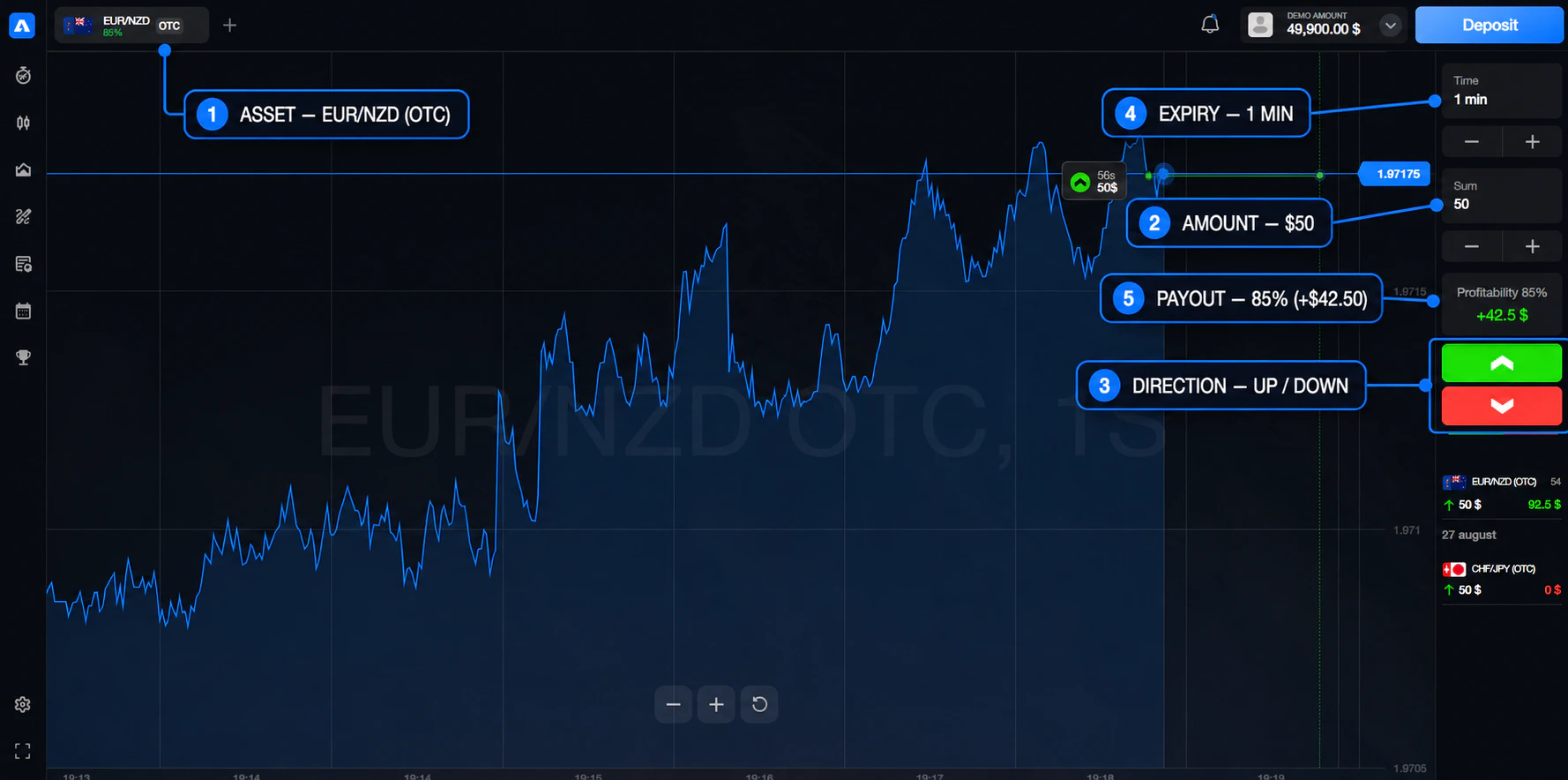
A fixed-time trade has five main parts:
- Underlying asset: the market price being followed, such as a currency pair or index.
- Trade amount: the amount exposed to the outcome.
- Direction: Up if you expect the expiry price to be higher, or Down if you expect it to be lower.
- Expiry: the exact time at which the result is determined.
- Displayed payout: the potential return for a correct forecast, shown before confirmation and subject to the platform's rules.
Once a trade has been accepted, it may not be possible to cancel or change it before expiry. Check the order summary carefully before confirming.
How an Up trade works
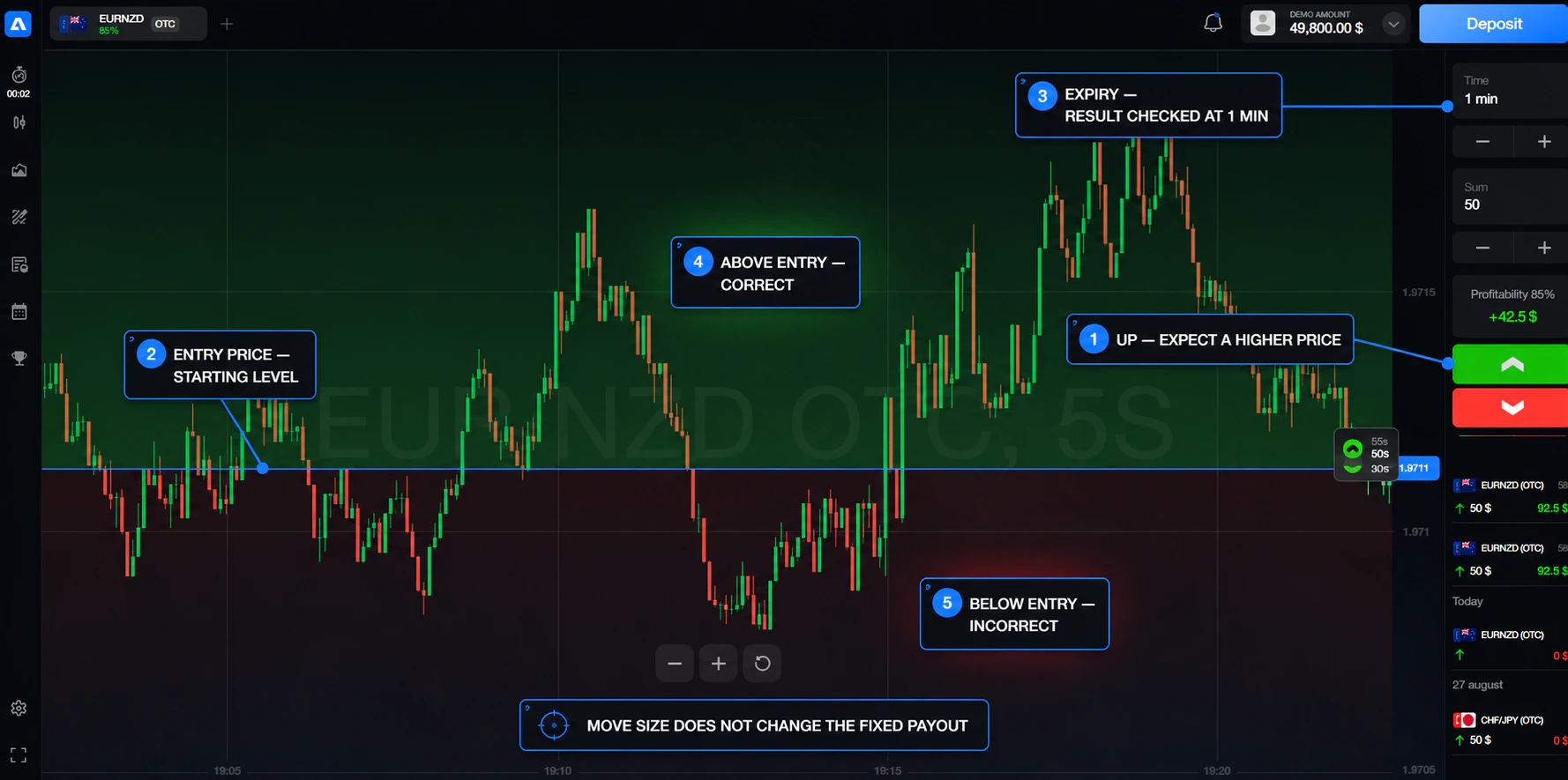
An Up trade expresses the view that the asset price will finish above the entry price at expiry.
Suppose EUR/USD is displayed at 1.10000 when a trader opens a $10 Up trade with a five-minute expiry. If the price used by the platform at expiry is 1.10001 or higher, the direction is correct. If it is 1.09999 or lower, the forecast is incorrect.
The size of the price move does not usually change the displayed fixed payout. A small move in the chosen direction and a large move may therefore produce the same result. This is different from spot or leveraged trading, where profit and loss generally vary with the distance moved.
How a Down trade works
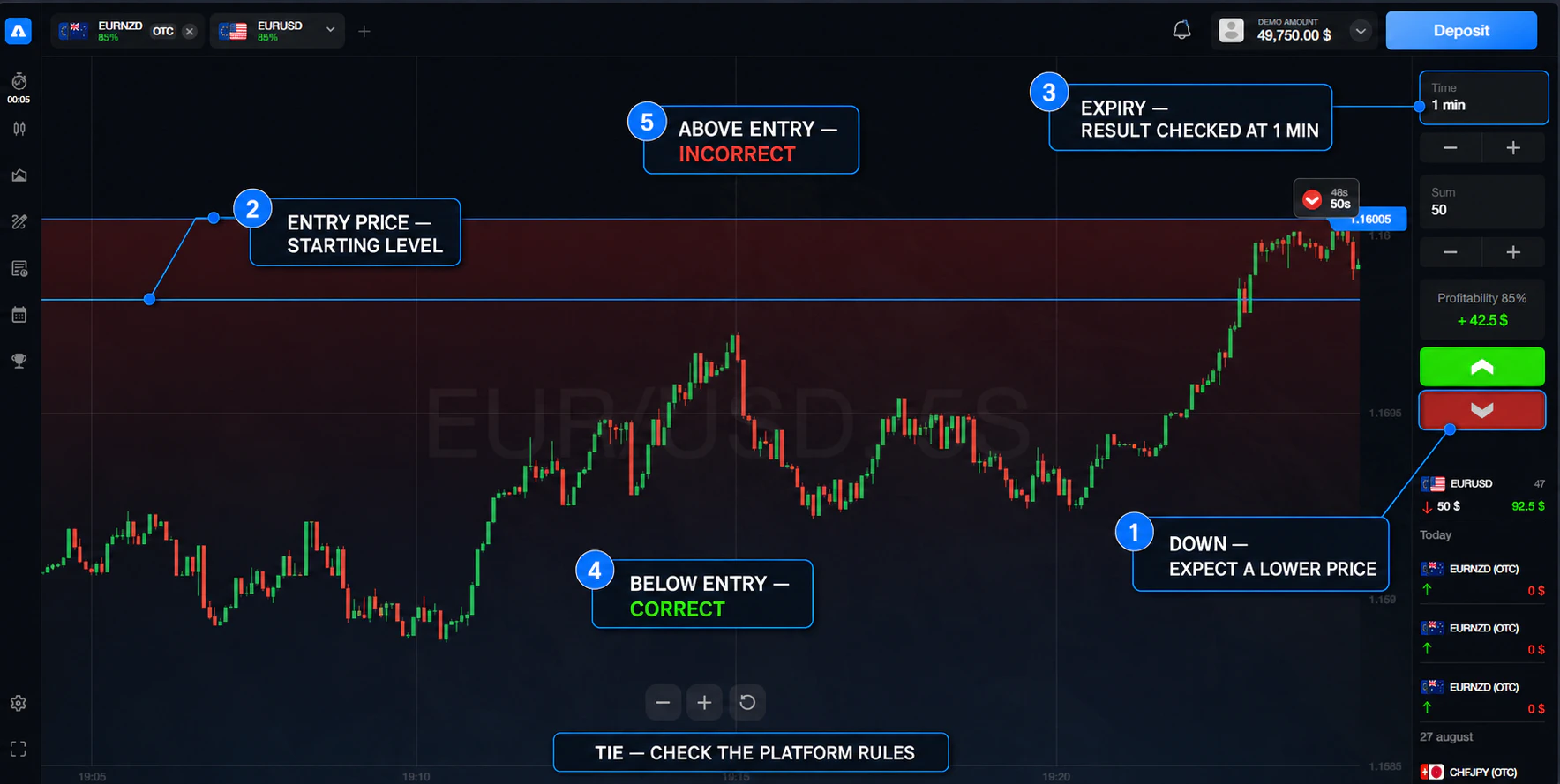
A Down trade expresses the view that the expiry price will be below the entry price.
If an asset is displayed at 100.00 when a Down trade begins, an expiry price below 100.00 may produce the stated payout. An expiry price above 100.00 normally results in the loss of the trade amount.
The platform's rules must explain what happens if the entry and expiry prices are exactly equal. Do not assume that every provider treats a tie in the same way.
Entry price, expiry time and expiry price
These three values determine the outcome:
|
Term |
Meaning |
Why it matters |
|
Entry price |
The price recorded when the trade is accepted |
This becomes the comparison level |
|
Expiry time |
The predetermined closing time |
A correct idea can still fail if the timing is wrong |
|
Expiry price |
The price recorded under the platform's pricing rules at expiry |
It is compared with the entry price to determine the result |
Traders should also understand that the price on one website may differ slightly from another because of data sources, update frequency, rounding or latency. The relevant price is the price determined under the platform's published trading and execution rules.
How the payout is calculated
Before confirmation, a fixed-time platform normally displays a potential payout percentage. If the trade amount is $10 and the displayed return on a correct forecast is 80%, the possible outcomes can be illustrated as follows:
|
Result |
Calculation |
Account change |
|
Correct forecast |
$10 × 80% |
+$8 net profit, with the $10 trade amount returned |
|
Incorrect forecast |
Trade amount lost |
-$10 |
|
Tie |
Depends on the published rules |
Must be verified |
The 80% figure is only an example. Actual percentages may differ by asset, time, account status and market conditions. Always use the percentage displayed in the trade ticket, not an old screenshot or promotional post.
Why win rate alone can be misleading
When the possible loss is larger than the possible net profit, a trader needs to be correct more than half the time just to break even before any other costs.
The approximate break-even accuracy is:
Break-even win rate = 1 ÷ (1 + payout rate)
|
Displayed net payout |
Approximate break-even accuracy |
|
70% |
58.82% |
|
80% |
55.56% |
|
90% |
52.63% |
At an 80% payout, five wins and five losses do not break even. Five successful $10 trades would generate $40 of net profit, while five unsuccessful trades would lose $50, leaving a $10 net loss.
This is why claims such as “more winning trades than losing trades” are incomplete. The result depends on both accuracy and payout.
How to place a fixed-time trade on Atlant Trade
The exact interface may change, but the process generally follows these steps:
- Open the platform and choose an available asset.
- Check whether the asset is currently open and review the displayed payout.
- Select the trade amount.
- Choose the expiry time.
- Review the chart, market context and relevant economic events.
- Select Up or Down only if the setup matches a written trading plan.
- Check the asset, amount, direction, payout and expiry one final time.
- Confirm the trade and allow it to reach expiry.
- Record the result and the reason for entry in a trading journal.
Beginners can use a demo account to learn where these controls are located. Demo results, however, do not guarantee live results and may not reproduce every psychological, technical or market condition of real trading.
Choosing an expiry time
Expiry should be connected to the timeframe used for analysis. A signal visible on a one-hour chart may not make sense for a one-minute expiry, while a very short-term pattern may no longer be relevant several hours later.
Before choosing an expiry, consider:
- the chart timeframe used to identify the setup;
- the average duration of recent price swings;
- nearby support and resistance;
- scheduled economic announcements;
- current volatility and liquidity;
- whether the asset's underlying market is open.
There is no universally “best” expiry. Shorter periods contain more market noise and leave less time for an analysis to develop. Longer periods can be affected by more events. Testing a consistent rule on a demo account is more useful than changing expiry after every loss.
Market price versus OTC price
Some platforms may offer assets outside the normal hours of an underlying exchange or market. These may be labelled OTC or otherwise identified separately. Their availability does not mean that the underlying exchange is open.
Before trading, check:
- how the instrument is labelled;
- where its price comes from;
- whether the pricing method differs outside regular market hours;
- whether payout and expiry conditions are different;
- whether the product is available and permitted in your jurisdiction.
Do not treat an OTC symbol as identical to an exchange-traded instrument simply because the names look similar.
Main risks of fixed-time trading
The full trade amount can be lost
An incorrect forecast can result in a 100% loss of the amount assigned to that trade. Several losses in a row can reduce an account quickly.
Short expiries amplify noise
Prices fluctuate from second to second. A technically reasonable market view can still finish on the wrong side of the entry price at the selected moment.
Payouts can change
The displayed percentage may vary. A method that appeared viable at one payout may have negative expectancy at a lower payout.
News can cause abrupt moves
Inflation reports, central-bank decisions, employment data and unexpected geopolitical events can produce gaps, spikes and rapid reversals.
Emotional decisions compound losses
Increasing the next trade after a loss, trading without a signal or trying to recover a daily loss quickly can turn a limited setback into a much larger one. Atlant Trade's current FAQ states that Martingale is prohibited; users should review all current trading restrictions before placing trades.
Regulatory and availability rules differ
Users in India should independently check whether a platform and product are authorised and permitted for their intended transaction. The Reserve Bank of India states that absence from its Alert List must not be interpreted as proof of authorisation. A platform's accessibility from India is not, by itself, a regulatory approval.
A risk-controlled beginner checklist
Before confirming a trade, ask:
- Can I explain the setup in one sentence?
- Does the signal have confirmation from price structure rather than one indicator alone?
- Is a high-impact announcement due before expiry?
- Is the displayed payout sufficient for the tested method?
- Is the amount within a predetermined risk limit?
- Have I avoided increasing the amount to recover a previous loss?
- Have I checked the correct asset, direction and expiry?
- Would I still take this trade if the previous trade had been a win?
If any answer is unclear, not trading is a valid decision.
Common beginner mistakes
- Choosing direction first and looking for a reason later. Analysis should come before the order.
- Using one indicator as a guarantee. RSI, Bollinger Bands and moving averages describe price behaviour; they do not predict outcomes with certainty.
- Ignoring payout changes. The same accuracy can produce different financial results at different payouts.
- Using an expiry unrelated to the chart. Timing must form part of the strategy.
- Trading every asset. Following a smaller number of instruments can make review more consistent.
- Judging a strategy after a few trades. A small sample can be dominated by chance.
- Treating demo profit as expected income. Real-money pressure changes behaviour, and live conditions may differ.
Frequently asked questions
Is fixed-time trading the same as buying an asset?
No. You do not take ownership of the underlying currency, share, index or commodity. You enter a contract whose result is based on the price direction at expiry under the platform's rules.
Can I close a fixed-time trade early?
Do not assume so. Atlant Trade's Risk Disclosure says an accepted fixed-time transaction cannot be cancelled, amended or closed before expiry unless the platform expressly provides otherwise.
Is a higher payout always better?
A higher payout improves the mathematical break-even point, but it does not make a poor setup reliable. Asset quality, timing, volatility and execution rules still matter.
Can technical indicators guarantee the result?
No. Indicators are calculated from historical price data. They can help organise analysis but cannot remove uncertainty.
How much should a beginner trade?
The platform minimum is not a recommended amount. A trader should first define an affordable loss limit and use the smallest practical exposure while learning. Never deposit or trade borrowed money.
Final takeaway
Fixed-time trading combines a simple decision with a demanding probability problem. A trader must be correct often enough to overcome the difference between the possible payout and the possible loss. Understanding expiry, price rules and break-even accuracy is therefore more important than searching for a guaranteed signal.
Use the demo account to learn the interface, verify all current product rules, keep the trade amount controlled and accept that skipping an unclear setup is part of disciplined trading.
Risk notice
Trading financial instruments and fixed-time contracts involves a significant risk of loss. You may lose the entire amount committed to a trade. Past or demo performance does not predict future results. This material is educational and is not investment, legal or tax advice. Check the applicable rules in your jurisdiction and consider independent professional advice before trading.