How Fixed-Time Trading Works: A Beginner's Strategy Guide
Fixed-time trading looks simple on the surface: pick a direction, pick a duration, wait for the result. That simplicity is exactly why beginners lose money fast — it's easy to open a trade with no plan at all, and just as easy to confuse "simple" with "easy to win."
This guide explains how a fixed-time trade actually works step by step, the terms you need to get right before you start, and a basic structure for approaching your first trades without guessing.
What Is Fixed-Time Trading?
Fixed-time trading is a way of trading where you forecast whether an asset's price will be higher or lower than its current level after a set period of time — the expiry. You choose the asset, the direction (up or down), the amount, and the expiry before you enter. Once the trade is placed, nothing about it changes until it settles.
There's no managing a stop-loss mid-trade and no scaling in and out. The entire outcome depends on one thing: where the price is at the exact moment of expiry compared to your entry.
How a Fixed-Time Trade Works, Step by Step
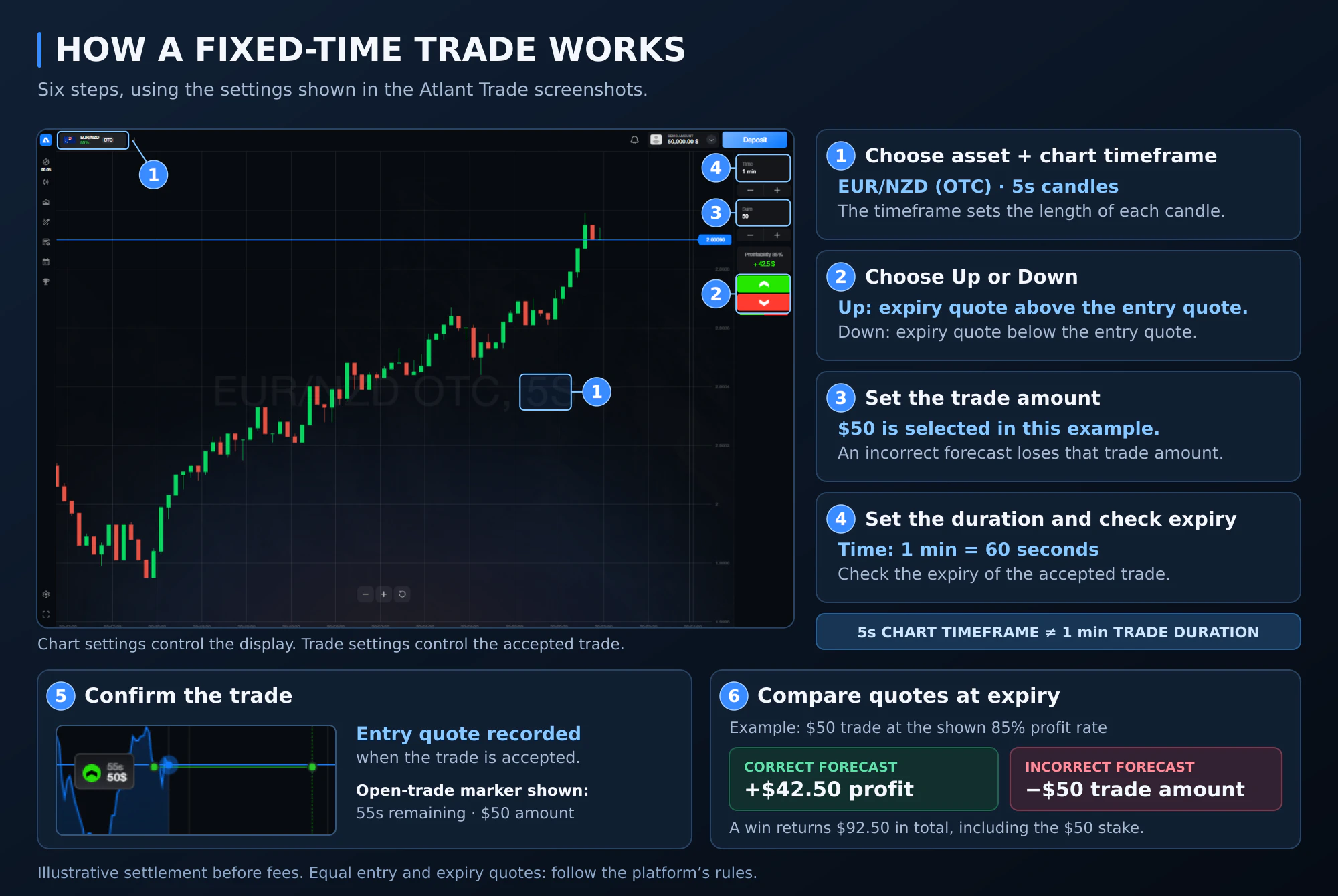
- You pick an asset and a chart timeframe. The timeframe (e.g. 1-minute candles) is what you look at to read the market — it is not the same as your trade's duration.
- You decide on a direction. Up means you expect the price to be higher at expiry than at entry. Down means you expect it to be lower.
- You set the trade amount. This is the maximum you can lose on this single trade if your forecast is wrong.
- You choose the expiry. This is a fixed amount of time from the moment your trade is accepted — for example, 60 seconds.
- You confirm the trade. The entry quote is locked in at this moment.
- The trade settles at expiry. If the settlement quote is on the correct side of your entry quote, the trade wins and pays out at the platform's displayed rate. If not, the trade loses the full amount.
Nothing in between matters. A trade that moves in your favour for 50 of its 60 seconds and reverses in the final second still loses. This is the core difference between fixed-time trading and holding a regular position - there's no partial outcome and no chance to exit early once the trade is placed.
Timeframe, Duration and Expiry Are Three Different Things
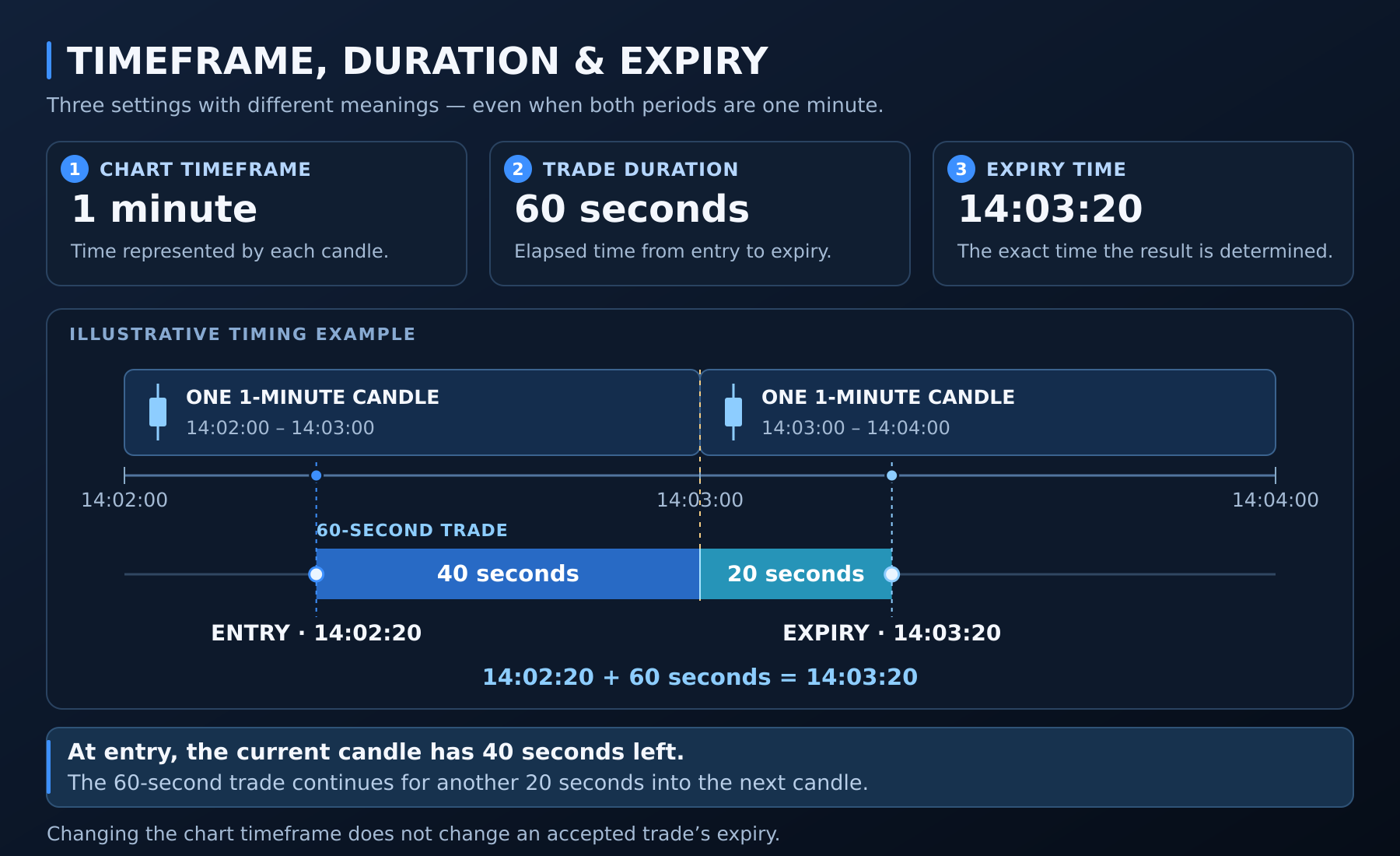
This is the single most common source of confusion for beginners, so it's worth being precise about it:
- Chart timeframe is how the chart groups price data - a 1-minute chart shows one candle per minute. It's how you read the market, not how long your trade lasts.
- Duration is how long your specific trade runs for, from entry to expiry - this can be shorter, longer, or unrelated to the candle timeframe you're watching.
- Expiry time is the exact clock time your trade settles. A trade entered at 14:02:20 with a 60-second duration expires at 14:03:20 - not whenever the current 1-minute candle happens to close.
Mixing these up is how traders misjudge what a chart is actually telling them about a trade already in progress. Our guide on fixed-time trading expiry time walks through this distinction in more detail.
Reading a Basic Setup: Trend, Level, Confirmation
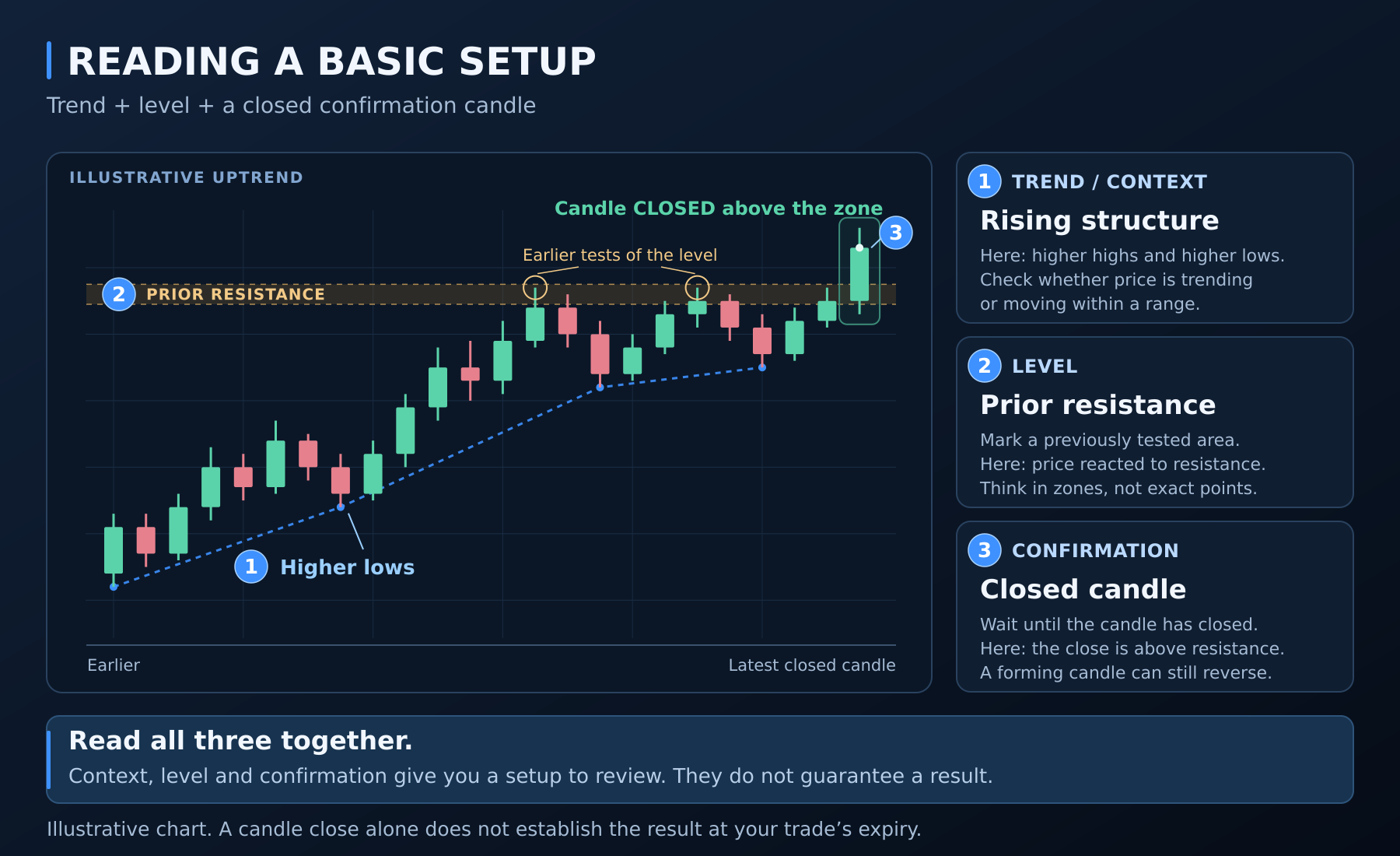
Fixed-time trading doesn't remove the need to read a chart - if anything, it makes reading it correctly more important, because you get one decision and no way to adjust. A basic beginner approach usually looks at three things together, not any one of them alone:
- Trend or context. Is price generally moving in a direction, or is it stuck in a range? Trading a breakout inside a strong trend is a different situation from trading the same pattern inside a flat range.
- A level. A price area that has mattered before - support, resistance, or a recent high or low the price has reacted to.
- Confirmation. Waiting for a candle to actually close in the direction you expect, rather than entering while it's still forming. A candle can look like a strong signal and then reverse before it closes.
None of these guarantee an outcome. They exist to give you a specific, repeatable reason for entering - one you can review afterwards and compare against what actually happened.
Payouts and Risk in Fixed-Time Trading
Every fixed-time trade has two possible outcomes, and only one of them returns anything: a win pays out at the platform's displayed rate, and a loss forfeits the full amount risked. There's no partial loss and no partial win.
Be precise about what the payout actually means. If you stake $10 at an 85% payout and win, you're credited $18.50 - your stake back plus $8.50 profit, not $18.50 in profit. A loss on the same $10 stake costs you the full $10. This asymmetry is why win rate alone doesn't tell you whether an approach is working - a strategy that wins half the time can still lose money overall once payouts are accounted for.
A Basic Approach for Your First Trades
Before you place a single fixed-time trade, it helps to write down a short, specific set of rules rather than deciding in the moment:
- Pick one asset and one chart timeframe to start with - don't split attention across several.
- Define your entry condition in one sentence - for example, "price breaks a level and the next candle closes beyond it."
- Fix your trade amount before the session, not per trade.
- Decide your expiry based on how long your setup typically needs to play out - not on what feels exciting.
- Set a limit on trades per session. Fixed-time trading's speed makes it easy to take far more trades than your setup actually justifies.
Writing this down before you start is what separates a repeatable approach from reacting to whatever the chart happens to be doing in the moment. Our guide on what a trading strategy should include covers this in more depth.
Common Mistakes Beginners Make
- Entering before confirmation. A candle that looks like it's about to close in your favour can still reverse - waiting costs you nothing but a small delay.
- Confusing chart timeframe with trade duration. A 1-minute candle closing is not the same as your trade expiring.
- Chasing a trade after missing the setup. If the original condition is gone, the trade is no longer the one you planned.
- Judging payout by percentage alone. An 85% payout still means a loss forfeits more than a win returns.
- Opening a trade just to have one open. Not every session offers a setup that matches your rules - and that's normal, not a problem to fix by lowering your standards.
Practise in Demo Mode Before Using Real Funds
An online trading demo account lets you go through this entire process - reading a setup, entering, waiting for expiry - with virtual funds instead of real ones. It's the most direct way to check whether your rules actually hold up before any real money is involved.
Keep a record while you practise. Our guide to keeping a trading journal shows a simple template for logging fixed-time trades with the fields that actually matter - entry and expiry time, quote, payout, and whether the trade followed your rules.
Frequently Asked Questions
Is Fixed-Time Trading the Same as Regular Trading?
No. In regular trading you hold a position that can be closed at any time, and profit or loss scales with how far the price moves. In fixed-time trading, the outcome is fixed at expiry — either the full payout or the full loss of the amount risked, regardless of how far price moved.
What Expiry Should a Beginner Start With?
There's no single correct answer — it depends on the setup you're using and how long it typically takes to play out. What matters more is picking one expiry rule and keeping it consistent, so you can actually compare results across trades later.
Does a Higher Payout Mean a Better Trade?
Not by itself. A higher payout usually reflects the platform's own pricing for that specific trade, not a signal about how likely it is to win. Judge a setup by its results over many trades, not by the payout percentage on one.
Risk notice: Trading involves a risk of losing the amount committed to a trade. Demo results and past performance do not guarantee future outcomes. This article is educational and does not provide personalised investment advice.