How to Choose an Expiry Time in Fixed-Time Trading
Choosing an expiry time is one of the most important decisions in fixed-time trading. Your forecast concerns the price at a particular moment. A market can move in the direction you expected and still finish on the wrong side of your entry price when the trade expires.
On Atlant Trade, understanding that timing starts with separating three settings: the chart timeframe, the trade duration and the exact expiry time. This guide explains those differences, shows why candle colour can be misleading and provides a practical exercise for learning the controls in a demo account.
If you are new to the product, begin with how fixed-time trading works for an introduction to Up and Down forecasts, payouts and settlement.
What is expiry time in fixed-time trading?
Expiry time is the predetermined moment when the closing quote is used to determine a trade's result. For an Up trade, the relevant expiry quote must be higher than the recorded opening quote. For a Down trade, it must be lower.
A move in your chosen direction before expiry does not lock in a successful result. The comparison is made at the specified endpoint. That makes the time setting part of your forecast, alongside the direction.
Chart timeframe, trade duration and expiry time
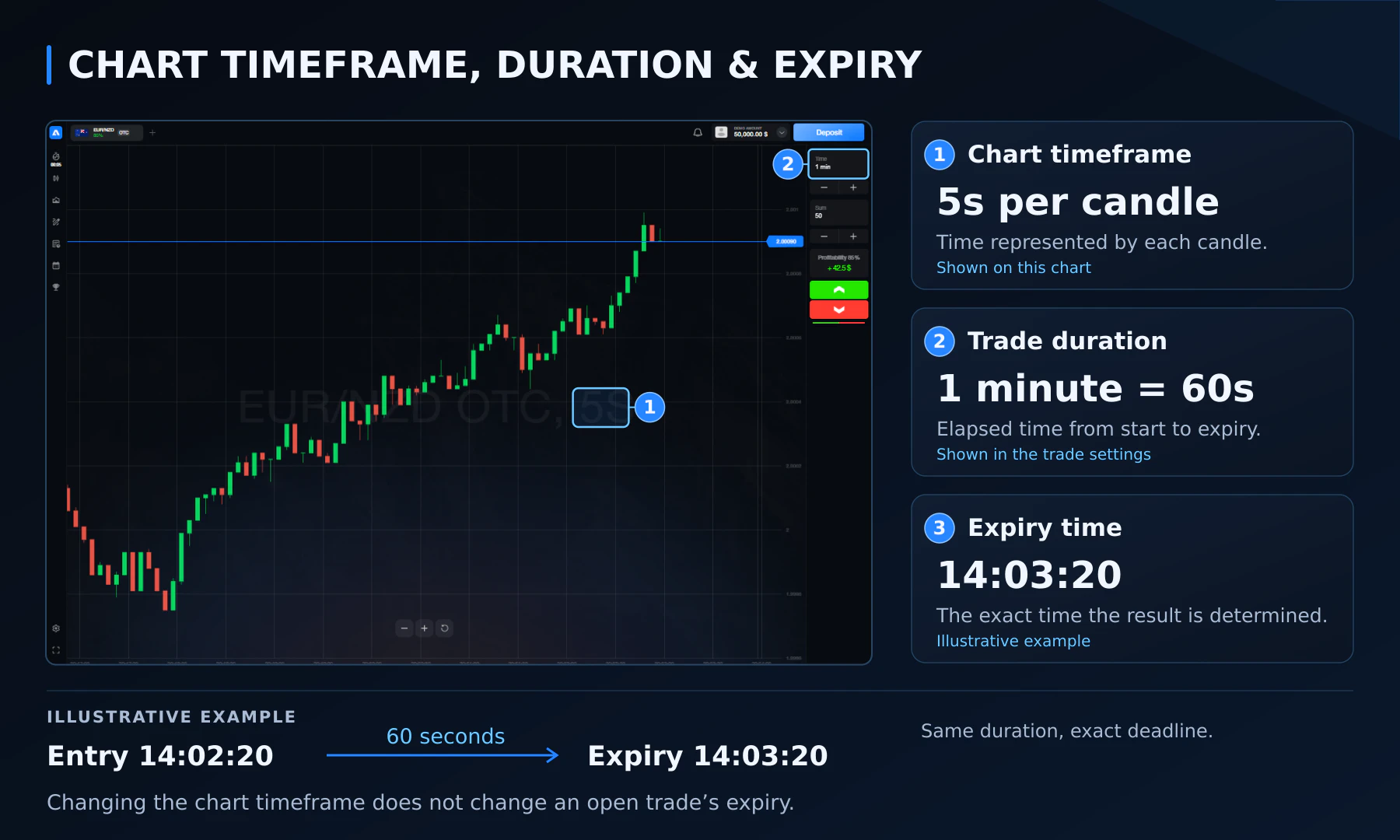
These terms describe different things, even when the interface displays the same number of minutes.
| Term | What it controls | Example |
|---|---|---|
| Chart timeframe | How much time each candle or bar represents. | A one-minute candle groups one minute of price data. |
| Trade duration | The length of the trade between its recorded start and expiry. | A 60-second duration represents one minute of elapsed time. |
| Expiry time | The exact date and time used for settlement. | 14:03:20 on the platform's displayed clock. |
For example, a trade recorded as starting at 14:02:20 and expiring 60 seconds later ends at 14:03:20. A one-minute chart candle covering 14:02:00 to 14:03:00 has only 40 seconds remaining at that entry point.
Both settings involve one minute, but their endpoints differ. A 60-second trade entered partway through a candle can span portions of two candles.
Read the expiry attached to the accepted trade. Changing the chart to five-minute candles changes the display of price history; it does not extend that trade's expiry. Our guide to chart types and timeframes explains how the chart settings work.
How different expiries can change the result
Consider a hypothetical Up forecast on EUR/USD with an opening quote of 1.10000 at 10:00:00. The following invented prices illustrate three possible endpoints along the same price path. They are not a forecast or a list of currently available trade durations.
| Time after entry | Illustrative quote | Compared with entry | Up forecast at that endpoint |
|---|---|---|---|
| 1 minute | 1.10012 | Higher | Correct |
| 3 minutes | 1.09990 | Lower | Incorrect |
| 5 minutes | 1.10025 | Higher | Correct |
The three-minute endpoint produces an incorrect Up forecast even though the price is higher after one minute and five minutes. Choosing the best-looking endpoint after seeing the whole path would give you information that was unavailable at entry.
The useful question before a trade is whether the chosen horizon belongs to a clearly defined, previously evaluated approach. Simply expecting the price to rise eventually leaves the timing unanswered.
Why a green candle can still mean a losing Up trade
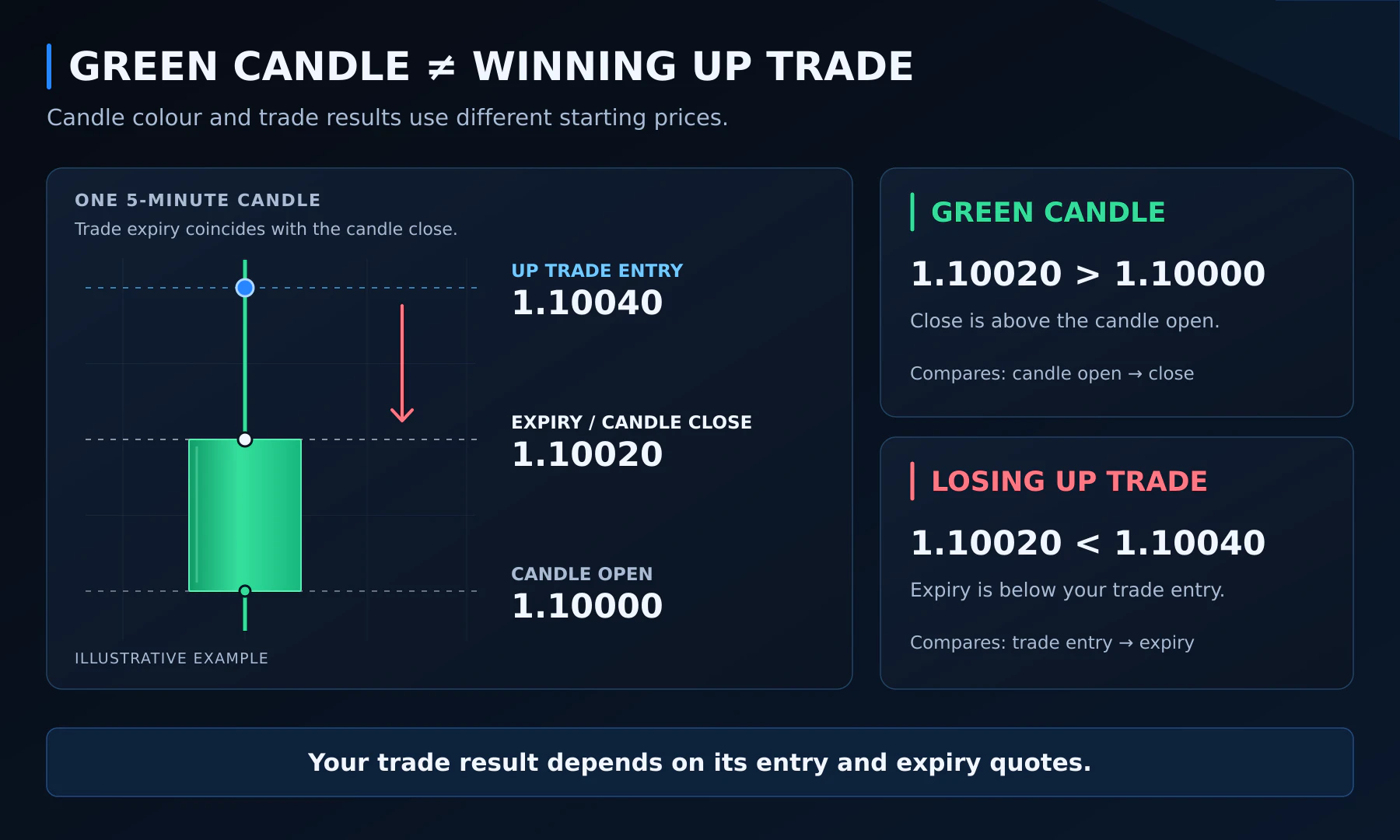
A candle's colour usually compares its closing price with its own opening price. Your trade compares the expiry quote with your trade's recorded opening quote. Those starting prices can differ.
Suppose a five-minute candle opens at 1.10000. You enter an Up trade later within that candle at 1.10040. The trade expires at the candle's closing time, when the quote is 1.10020.
- The candle closes above 1.10000, so it appears green under the usual colour convention.
- The expiry quote is below your entry of 1.10040, so the Up forecast is incorrect.
The same distinction applies to Down trades and red candles. Read the actual opening and expiry quotes when reviewing a result. Candle colour alone cannot establish whether your trade succeeded.
How to choose an expiry time before entering
1. Define the movement you are trying to evaluate
Describe the setup and its expected time horizon. An immediate reaction to a price level and a broader trend continuing through several pullbacks are different ideas.
Write down the event required before entry. For example, a practice rule might require a completed candle to close beyond a defined level. The observation is then specific enough to record and review. It still does not establish that the next trade will succeed.
2. Keep the entry rule and timing rule together
Record when the signal became available and when the trade was accepted. Entering well after a signal changes both the opening quote and the relationship between the setup and expiry.
If a rule depends on a candle closing, the decision must use information available after that close. A backtest that assumes an entry before the confirming candle finished gives the strategy an unrealistic advantage.
Decide in advance what counts as a late entry. If that limit has passed, record the missed setup and wait for another qualifying situation.
3. Review what could happen before the deadline
Check whether the proposed trade would remain open through a scheduled announcement, an asset's trading-session boundary or another condition excluded by your practice rules.
A longer duration increases the amount of time during which conditions can change. A shorter duration makes small timing differences a larger proportion of the trade. For context, a two-second difference represents about 3.3% of a 60-second duration and about 0.7% of a five-minute duration. These percentages measure elapsed time, not the probability of losing.
Learn more about how economic news affects financial markets before including announcement periods in a test.
4. Check the available trade conditions
Use the durations, asset availability and potential payout shown in your Atlant Trade account. Check the exact expiry and accepted opening quote in the trade record. The timestamp on your phone or an external chart may not use the same clock or price source.
Keep the trade amount within your predefined loss limit. Choosing a different expiry does not reduce the amount committed to an unsuccessful trade.
Should expiry equal a fixed number of candles?
A rule such as “expire after three candles” can be a testable hypothesis, but it needs a precise definition.
Does it mean three full candle periods after acceptance, or the close of the third candle counted on the chart? If the trade starts halfway through a candle, those endpoints can differ.
Replace an ambiguous rule with a measurable one, such as a stated duration after the recorded start, using an option actually available in the account. There is no universal candle multiplier that makes a strategy profitable. Changing the timeframe also changes how much elapsed time that multiplier represents.
A practical expiry exercise on the Atlant Trade demo account
An online trading demo account lets you practise reading these settings with virtual funds. For the first exercise, focus on explaining the timing and settlement of each trade.
- Select the demo balance. Confirm that the account uses virtual funds before placing a practice trade.
- Choose one available asset and chart timeframe. Keep them unchanged throughout the exercise so the records remain comparable.
- Write one entry condition and choose an available duration. Decide both before watching for the next qualifying setup.
- Record the accepted trade. Note the actual opening quote, start time, expiry, direction, amount and displayed potential payout.
- Observe the settlement. Compare the recorded expiry quote with the opening quote and explain the outcome.
- Review timing mistakes separately from results. Flag a late entry, incorrect duration or wrong balance even if the trade happened to succeed.
A handful of observations can reveal that you misunderstood a control. It cannot establish a profitable strategy. When you move on to comparing expiry rules, use the more complete process in how to test a trading strategy.
What to record when comparing expiry rules
Keep enough information to reconstruct the decision without relying on memory:
- Asset and price source.
- Chart timeframe and the exact entry condition.
- Signal time and accepted trade start time.
- Recorded opening quote, direction and trade amount.
- Chosen duration and exact expiry time, with the time zone.
- Applicable potential payout and recorded expiry quote.
- Net result and any rule deviation.
Compare candidates selected before reviewing their outcomes. Keep the same entry definition and avoid selecting one expiry for winning examples and another for losing examples.
Also distinguish executed demo trades from hypothetical observations. An observed chart price is not proof that a trade would have been accepted at that quote or payout. If those details are unavailable, the comparison remains an estimate.
Frequently asked questions
What is the best expiry time for beginners?
No expiry is best for every asset, setup or market condition. A useful starting point for learning is a single available duration that you can explain and record consistently. Evaluate the rule across more than a few outcomes before drawing conclusions.
Does a five-minute chart require a five-minute trade?
No. The chart groups price data into five-minute candles. The trade's expiry is a separate setting. Their relationship should be defined by the approach you are evaluating.
Can I extend a losing trade after it starts?
Do not plan around that possibility. After acceptance, an Atlant Trade transaction cannot be amended or cancelled unless the interface explicitly offers an applicable function. Changing the chart or selecting a duration for the next trade does not alter the existing transaction. See the trade execution and settlement rules for the applicable conditions.
What happens when the opening and expiry quotes are equal?
On Atlant Trade, equal recorded opening and expiry quotes result in the trade amount being returned without profit or loss. Use the quotes recorded for the transaction; visually similar prices on a chart may not reveal their full comparison precision.
Does a longer expiry make a trade safer?
It changes the timing of the forecast. It does not guarantee a better outcome or reduce the amount at risk. A longer horizon can include additional price swings and events.
Before your next practice trade, explain its timing in one sentence: “I am evaluating this setup from the accepted opening quote until this exact expiry.” If you cannot identify that endpoint, resolve the setting before confirming the trade.
Risk notice: Fixed-time trading involves a high risk of loss. An unsuccessful trade can lose the full amount committed. Demo results and historical tests do not guarantee future performance.