Currency Pairs for Beginners: Majors, Volatility and Risk
A currency pair shows how much of one currency is needed to buy one unit of another. Understanding the base currency, quote currency, market session and product rules is essential before analysing a pair or placing a fixed-time transaction.
This guide explains major, cross and exotic currency pairs, how quotes and pips work, what drives volatility, and what readers in India should verify before using an online trading platform. It is educational and does not identify a safest or most profitable pair.
What is a currency pair?
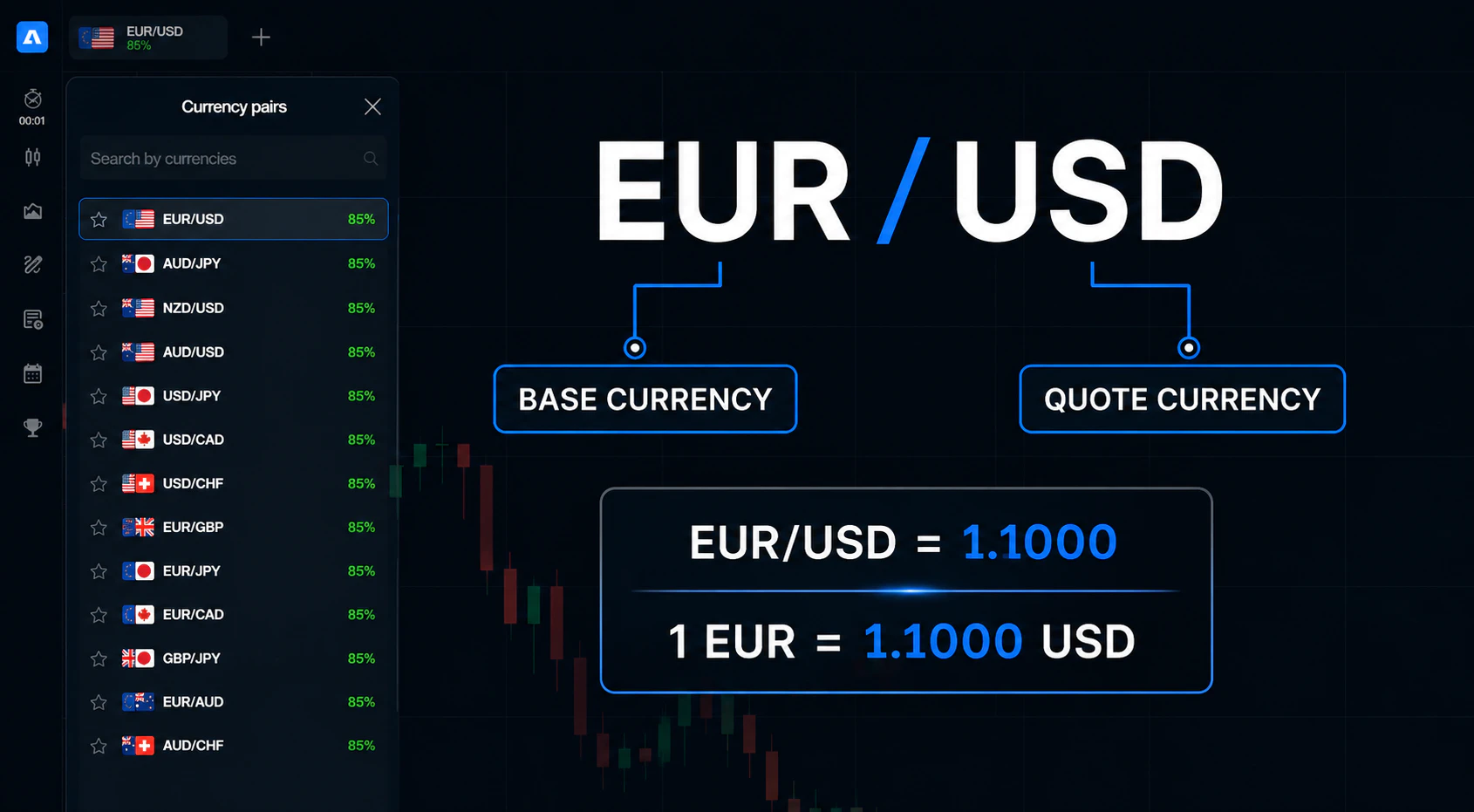
Every currency pair contains three basic elements:
- Base currency: the first currency in the pair.
- Quote currency: the second currency in the pair.
- Exchange rate: the amount of quote currency corresponding to one unit of the base currency.
For EUR/USD = 1.1000:
- EUR is the base currency;
- USD is the quote currency;
- one euro is priced at 1.1000 US dollars.
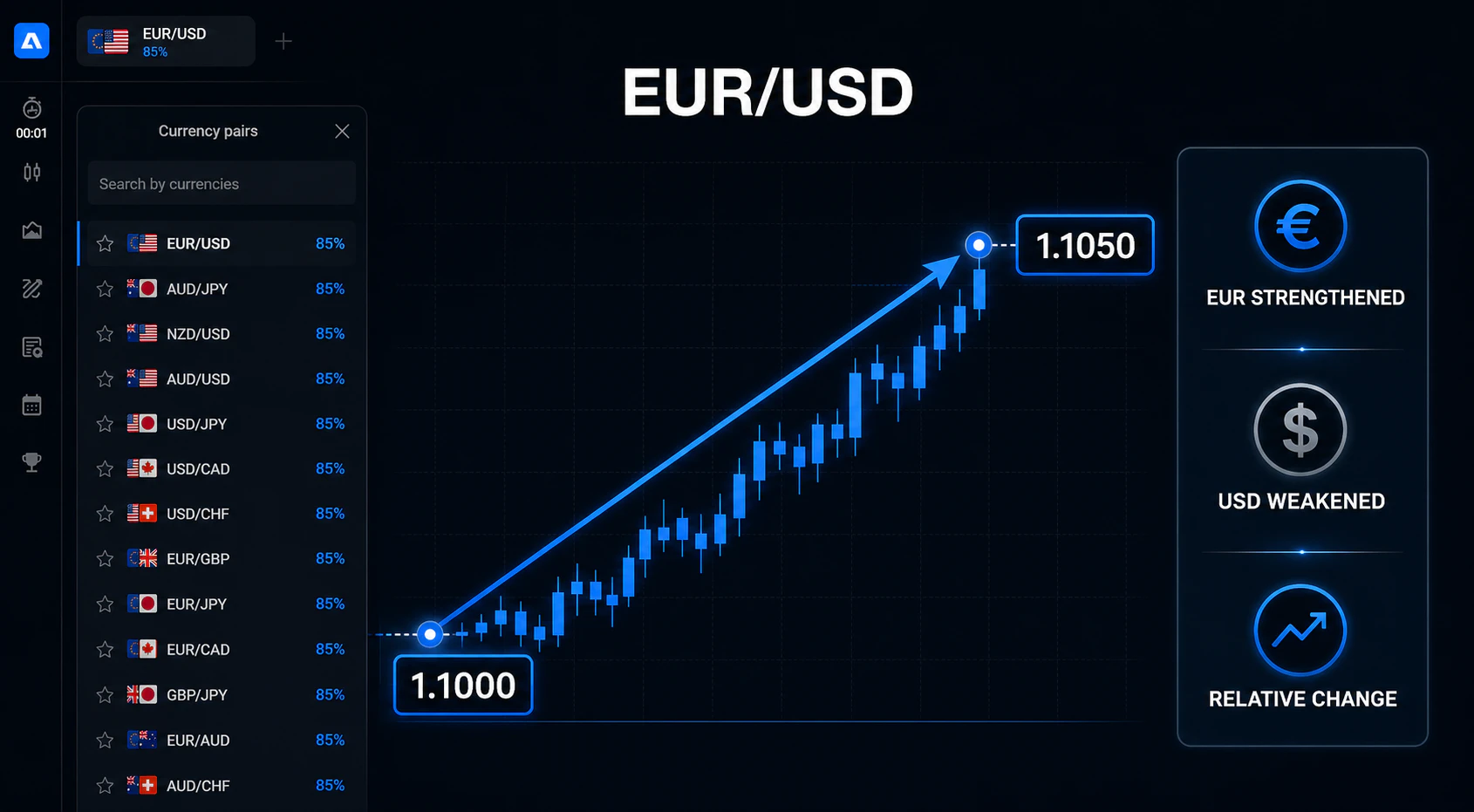
If EUR/USD rises from 1.1000 to 1.1050, the euro has strengthened relative to the US dollar over that interval, the dollar has weakened relative to the euro, or both forces have contributed. The quote shows the relative change; it does not identify the economic cause by itself.
How Up and Down relate to a currency pair
In an Atlant Trade fixed-time transaction:
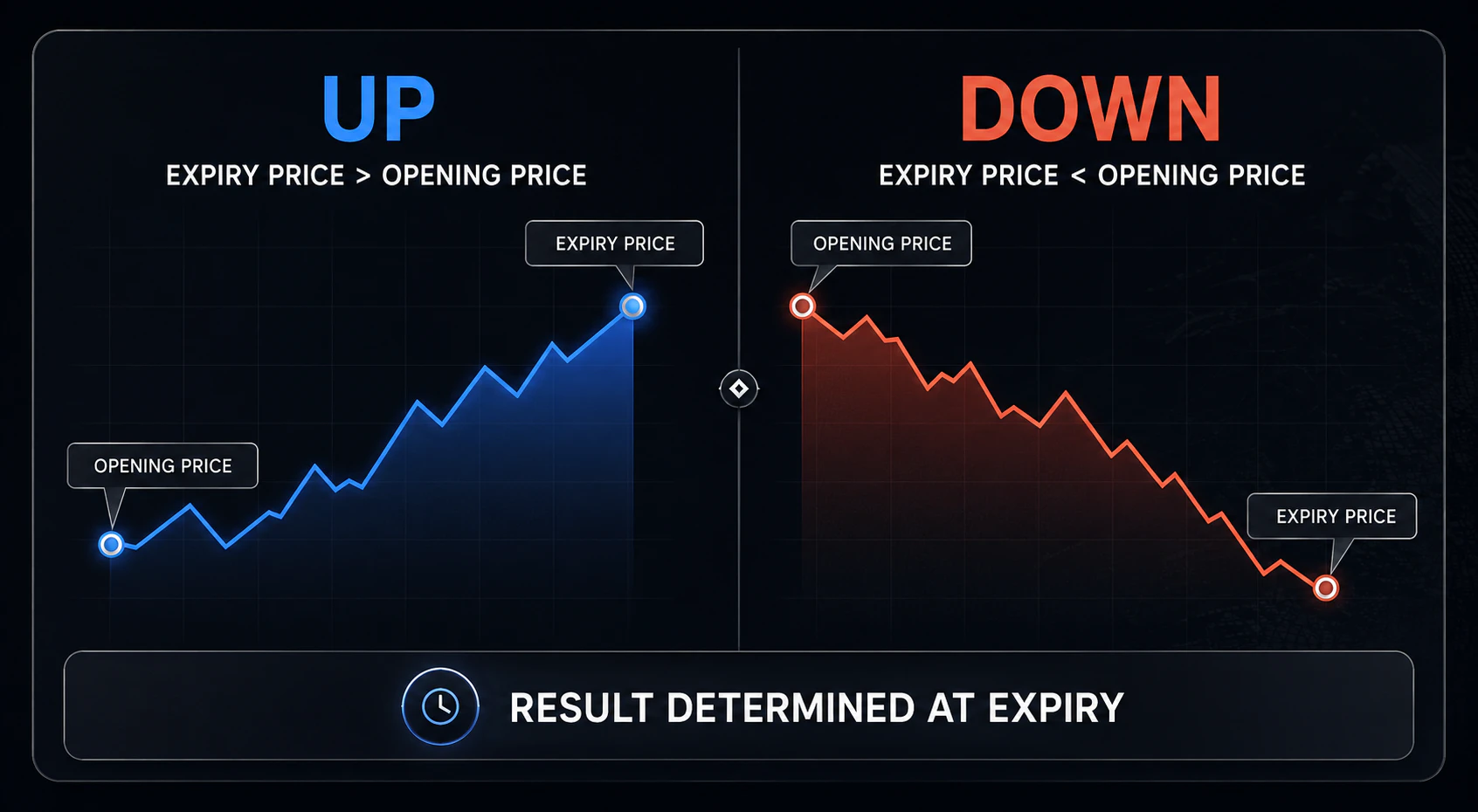
- Up: a forecast that the applicable quote at expiry will be above the recorded opening quote.
- Down: a forecast that the applicable quote at expiry will be below the recorded opening quote.
The user does not buy or take delivery of the underlying currencies. Settlement is based on the Platform quote and Trading Rules. Atlant Trade's Risk Disclosure states that an equal opening and expiry quote closes with no profit or loss and the trade amount is returned, but users should always review the current rules before confirming a transaction.
What is a pip?
A pip is a conventional unit used to describe a change in a currency quote. For many pairs, one pip is 0.0001. For many Japanese-yen pairs, one pip is 0.01. Some price feeds display an additional decimal place, often called a pipette or fractional pip.
| Example | Price movement | Conventional change |
|---|---|---|
| EUR/USD | 1.1000 to 1.1050 | 50 pips |
| USD/JPY | 150.00 to 150.50 | 50 pips |
Pips describe price movement, not guaranteed profit. In fixed-time trading, a small move in the selected direction and a large move may produce the same displayed payout, depending on the contract rules.
Major, cross and exotic currency pairs
| Category | Meaning and examples | What beginners should know |
|---|---|---|
| Major pairs | Pairs the US dollar with another heavily traded currency, such as EUR/USD, USD/JPY, GBP/USD, USD/CHF, AUD/USD, USD/CAD and NZD/USD. | High participation can support liquidity, but it does not make the pair safe or predictable. |
| Crosses | Pairs two currencies without the US dollar, such as EUR/GBP, EUR/JPY, GBP/JPY and AUD/JPY. They are also often called minor pairs. | Two different regional sessions and policy outlooks can create rapid or uneven movement. |
| Exotic pairs | Usually combine a major currency with a less widely traded or emerging-market currency. | They may have lower liquidity, wider bid-ask spreads in spot markets, larger gaps and less continuous price behaviour. |
The Bank for International Settlements reported that the US dollar was on one side of 89.2% of global foreign-exchange trades in April 2025. This explains why USD pairs dominate global activity, but it is not evidence that every USD pair is suitable for every user.
What moves currency pairs?
- Interest rates and central banks: current policy, expected future policy and central-bank guidance can change the relative appeal of currencies.
- Inflation: price data can change interest-rate expectations, but the market reaction depends on forecasts and prior positioning.
- Employment and growth: jobs reports, GDP, retail sales and business surveys can alter expectations for demand and policy.
- Political and geopolitical events: elections, conflict, sanctions and trade policy can change risk perception rapidly.
- Commodity prices: currencies of commodity-exporting economies may respond to oil, metals or agricultural prices, although the relationship is not constant.
- Market sentiment: during stress, participants may reduce risk or prefer currencies perceived as more liquid or defensive. Historical relationships can break down.
The guide How Economic News Affects Financial Markets explains how actual, forecast and previous values can influence market reactions.
Liquidity, volatility and payout are different
- Liquidity: how readily market participants can transact without causing a large price change.
- Volatility: the size and speed of price movement. High volatility may create more movement but also more uncertainty, gaps and reversals.
- Bid-ask spread: the difference between buying and selling quotes in spot or leveraged markets. It is not the same as a fixed-time payout.
- Displayed payout: the potential return shown for a successful fixed-time forecast. It may vary by pair, expiry, session and market conditions.
A high payout does not show that a pair is easier to forecast. Low liquidity and short expiries can make small quote changes decisive. Quotes displayed by Atlant Trade may also differ from third-party prices because settlement uses the Platform's recorded quote under its Trading Rules.
Currency sessions from India
Global spot FX activity generally moves through Asia-Pacific, European and North American weekday sessions rather than one central exchange. The table below identifies common observation windows for users in India; it is not a trading recommendation or a promise of liquidity.
| Pair | Sessions commonly monitored from India | Scheduled influences |
|---|---|---|
| EUR/USD | London afternoon/evening; New York evening/night | ECB, Federal Reserve, euro-area and US data |
| GBP/USD | London and New York | Bank of England, UK data, Federal Reserve, US data |
| USD/JPY | Tokyo morning/afternoon; New York | Bank of Japan, Federal Reserve, Japanese and US data |
| AUD/USD | Asia-Pacific morning; New York | Reserve Bank of Australia, Australian/Chinese data, Federal Reserve |
| USD/CAD | New York evening/night | Bank of Canada, oil, Canadian and US data |
Exact clock times shift when countries enter or leave daylight-saving time. Platform availability may also differ from regular-market activity, especially for symbols labelled OTC. Check the current asset schedule and economic-calendar time zone before each session.
How to select a currency pair for study
- Confirm availability. Check that the symbol is clearly identified and available during the period you plan to observe.
- Understand the product. Identify whether it is a regular-market reference, an OTC symbol or another platform-specific contract.
- Check both currencies. Follow the central banks, economic releases and political events relevant to both sides of the pair.
- Review price behaviour. Study enough chart history to see how the pair behaves in trends, ranges, quiet periods and news-driven volatility.
- Practise consistently. Use the same written process across a meaningful demo sample before considering real funds.
The Atlant Trade demo account guide explains the limitations of virtual-fund practice. Demo results do not guarantee live results.
Reading pair movement and correlation
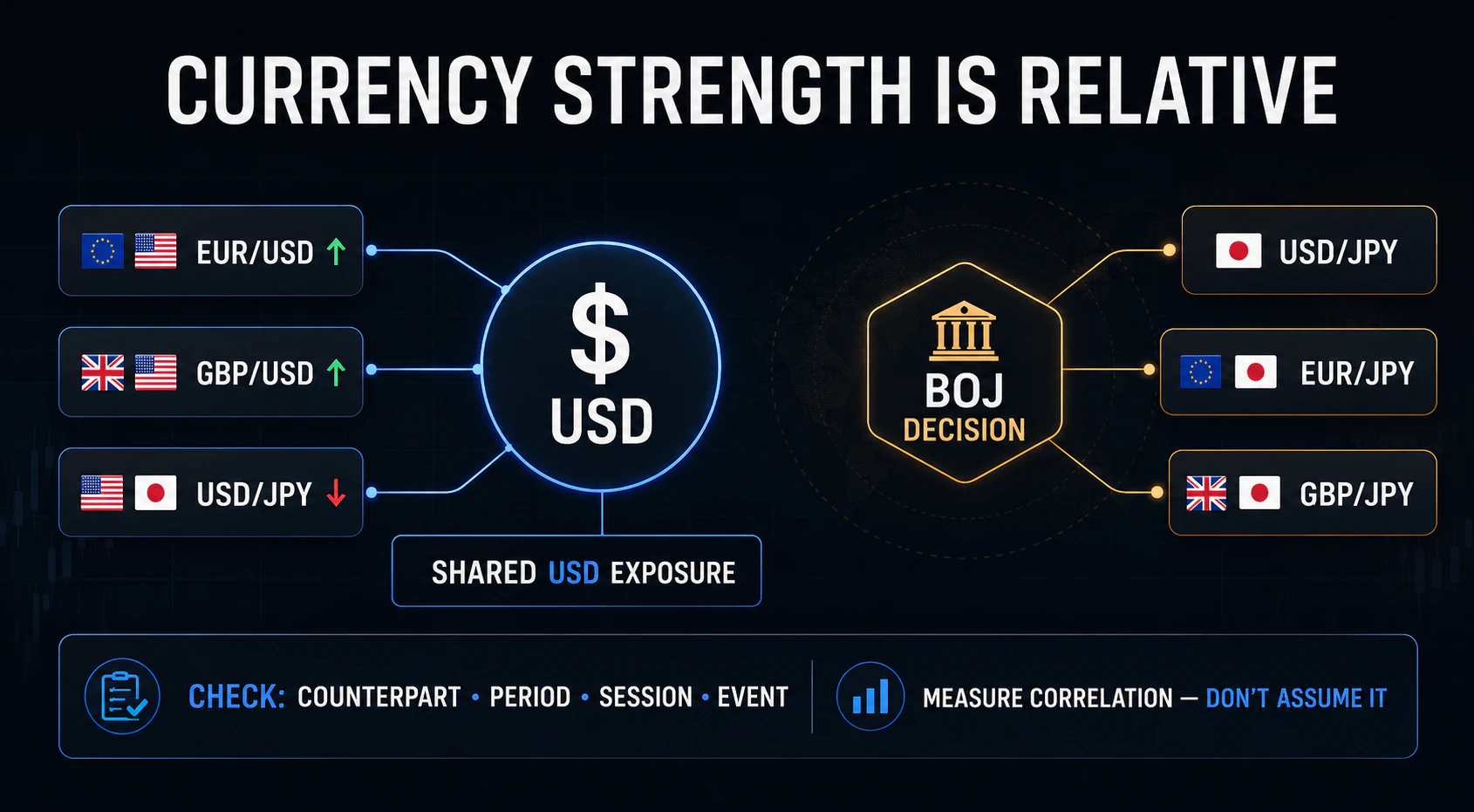
A statement such as 'the US dollar is strong' is incomplete unless it specifies the counterpart currency, measured period, session and relevant event. A currency can rise against one counterpart and fall against another at the same time.
Several trades may also express one concentrated currency view:
- Up on EUR/USD and Up on GBP/USD may both depend on US-dollar weakness;
- Down on USD/JPY and Up on EUR/USD may also share a US-dollar exposure;
- several JPY crosses may all react to the same Bank of Japan decision.
Correlations change across periods and market conditions. They should be measured rather than assumed, but checking repeated exposure can still reduce accidental concentration.
Technical analysis for currency pairs
Common tools include market structure, swing highs and lows, support and resistance, candlestick context, moving averages, RSI, Bollinger Bands and volatility measures. None predicts the future or guarantees a result.
Beginners can study Chart Types and Timeframes, Support and Resistance in Trading and Improving Trading Performance With Controlled Risk before building a checklist. For fixed-time trading, even a correct broader view can expire incorrectly if the selected period is too short or crosses a sudden event.
Common beginner mistakes
- selecting a pair only because the displayed payout is high;
- trading an unfamiliar symbol after one large candle;
- confusing the base and quote currencies;
- following news for only one side of the pair;
- treating major pairs as safe;
- opening several correlated trades at the same time;
- using an indicator without checking price structure and market conditions;
- changing pairs or increasing the amount after every loss.
Pre-trade currency-pair checklist
- What are the base and quote currencies?
- Which regular-market session is active?
- Is high-impact news scheduled before expiry?
- Is the symbol regular-market, OTC or otherwise platform-specific?
- What quote source and settlement rules apply?
- What are the current payout, amount at risk and expiry?
- Does another open trade create correlated exposure?
- Is the amount within the predetermined loss limit?
Frequently asked questions
Which currency pair is best for beginners?
There is no universally best pair. Heavily traded pairs may have extensive educational coverage and active sessions, but they can still move sharply. A small watchlist is easier to study consistently than a long list of unfamiliar symbols.
What does EUR/USD mean?
It is the number of US dollars quoted for one euro. EUR is the base currency and USD is the quote currency.
Are major pairs less risky than exotic pairs?
Majors are often more liquid in the underlying market, but they are not low risk. Product structure, expiry, trade amount, news, payout and execution rules also affect risk.
Can I trade currency pairs all day from India?
Regular global FX activity runs across weekday sessions, but each platform asset has its own availability. Technical access does not override Indian regulatory restrictions or the provider's legal status.
Does a currency pair represent ownership of currency?
Not necessarily. Atlant Trade states that its fixed-time transactions are cash-settled contracts based on the displayed quote rather than purchases of the underlying currencies.
Does a high payout mean a better pair?
No. The displayed payout describes a potential contract return, not the probability of a correct forecast. A higher figure does not make the market easier to analyse.
Final takeaway
Currency pairs are easier to analyse when the user separates the base currency, quote currency, session, economic drivers, product structure and legal context. The goal is not to find a pair that always works, but to apply and review one consistent process to a small watchlist.
Risk notice
Risk warning: Fixed-time currency transactions can lose the full trade amount, and repeated losses may exhaust the account. No pair or strategy guarantees profit. Past and demo results do not predict future performance. Use only funds you can afford to lose. This material is educational, not financial, legal or tax advice. Review the Atlant Trade Risk Disclosure before using real funds.