Fixed-Time Trading Strategies for Beginners
Fixed-time trading strategies for beginners start with a repeatable set of conditions: market context, an entry trigger, a trade amount and an expiry rule. On Atlant Trade, you can practise these conditions in demo mode and record how consistently you apply them.
This guide introduces three strategy frameworks for demo testing, explains how to interpret candles in context and shows how to define an expiry rule. These are educational starting points, not strategies with demonstrated profitability. If you haven't read how the mechanics of a fixed-time trade work yet, start with our guide on how fixed-time trading works first.
Before You Pick a Strategy, Fix Three Things
Every strategy below assumes you've already decided these - pick a strategy after fixing these, not instead of fixing them:
- One asset and one chart timeframe. Keeping these settings consistent makes it easier to compare observations while learning. If you use more than one timeframe, define the role of each before testing.
- A fixed amount you're willing to risk per trade. Decide this before the session, not while looking at a chart that's moving.
- Session limits. Define a maximum loss and a maximum number of trades before starting. Stop when either limit is reached.
Strategy 1: Trend Continuation With a Pullback
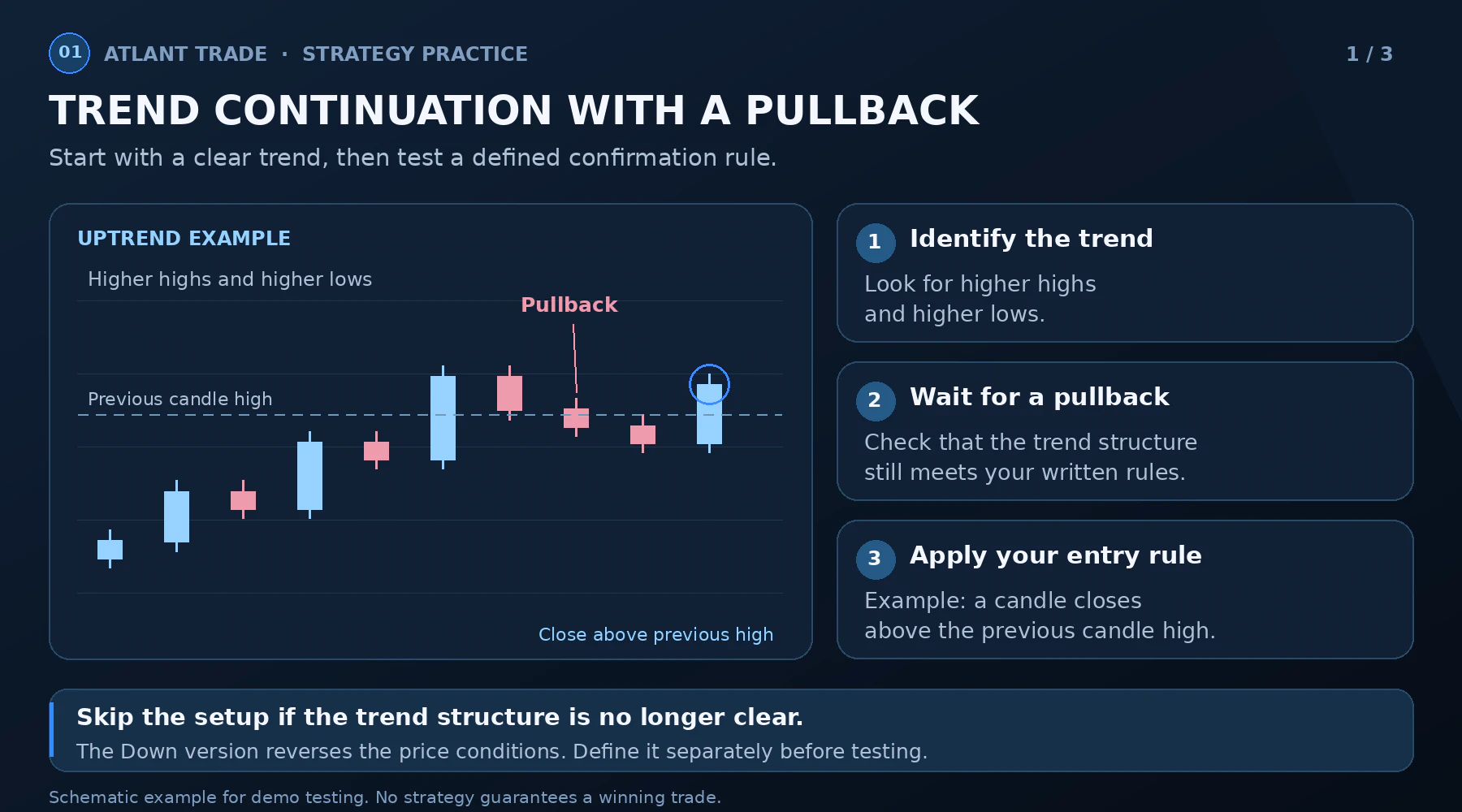
This approach looks for a market that's already moving in a clear direction, then waits for a small pause or pullback before entering in the same direction as the trend.
- Confirm price has been making higher highs and higher lows (for an Up bias) or lower highs and lower lows (for a Down bias) over recent candles.
- Wait for a brief pullback against that trend - a few candles moving the opposite way.
- Define a confirmation rule before testing, such as a candle closing above the previous candle's high for an Up setup, or below its low for a Down setup. A close meeting this rule does not prove that the pullback has ended.
A sideways market can resemble a pullback without providing a clear trend. Skip the setup when the recent swing structure is unclear or the pullback has broken the level your rules use to define the trend. Treat this as a reason not to enter, rather than a rule for cancelling an accepted fixed-time trade.
Strategy 2: Level Breakout With Confirmation
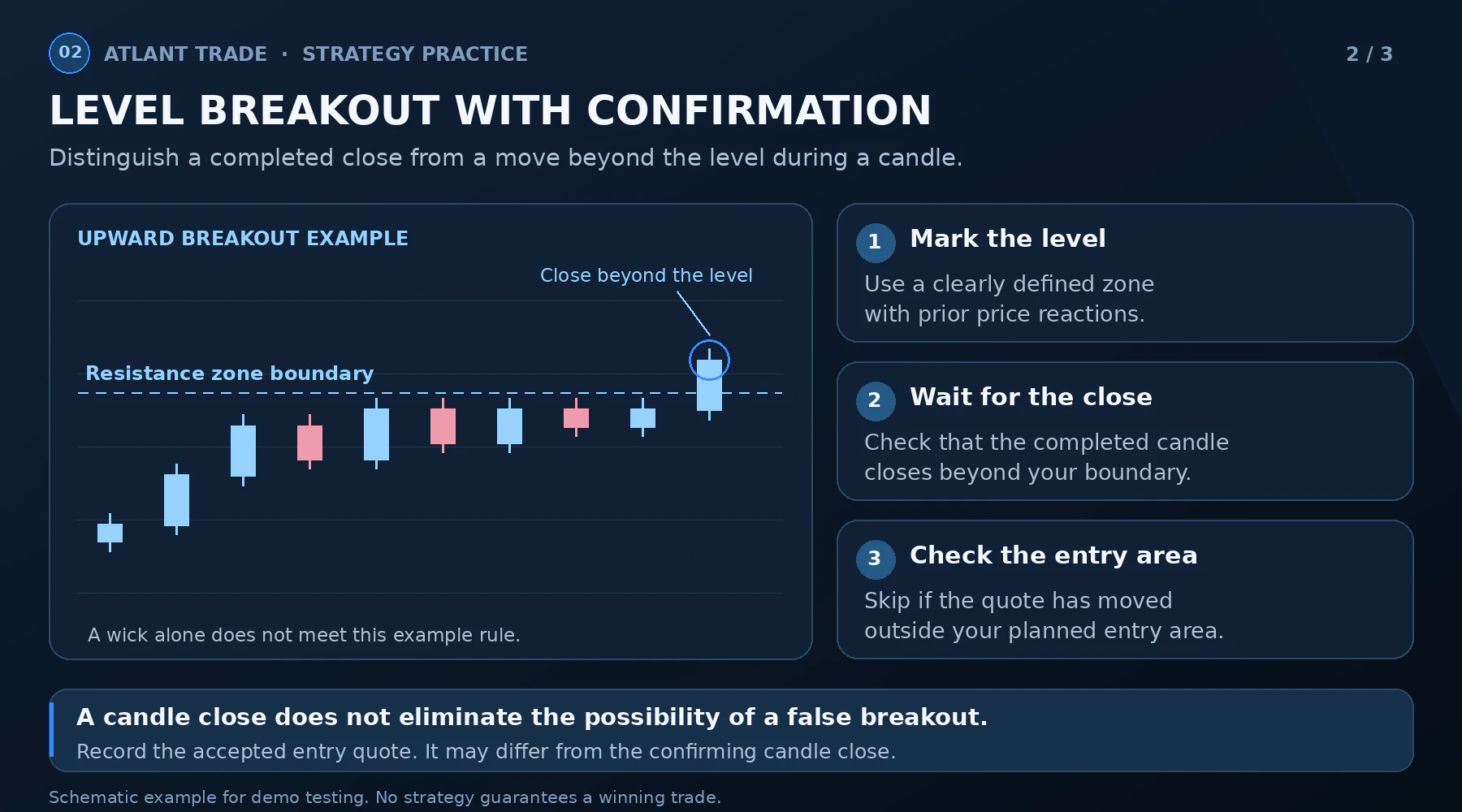
This approach trades the moment price breaks through a level that has mattered before - a recent high, a recent low, or a level price has bounced off more than once.
- For this practice framework, mark a recent high, low or price zone with at least two separate reactions. Use the same definition throughout the test; two reactions alone do not establish reliability.
- Wait for a candle to close clearly beyond that level, not just touch it.
- Consider the breakout direction only after the candle closes and the remaining conditions in your plan are met. Record the actual entry quote rather than assuming you can enter at the candle's closing price.
An unfinished candle can move beyond a level and then close back inside it. Waiting for a close avoids acting on that unfinished signal, but false breakouts can still occur afterward. Skip entries that have moved beyond your predefined entry area, and test any retest requirement as a separate rule.
Strategy 3: Range Reversal at Support or Resistance
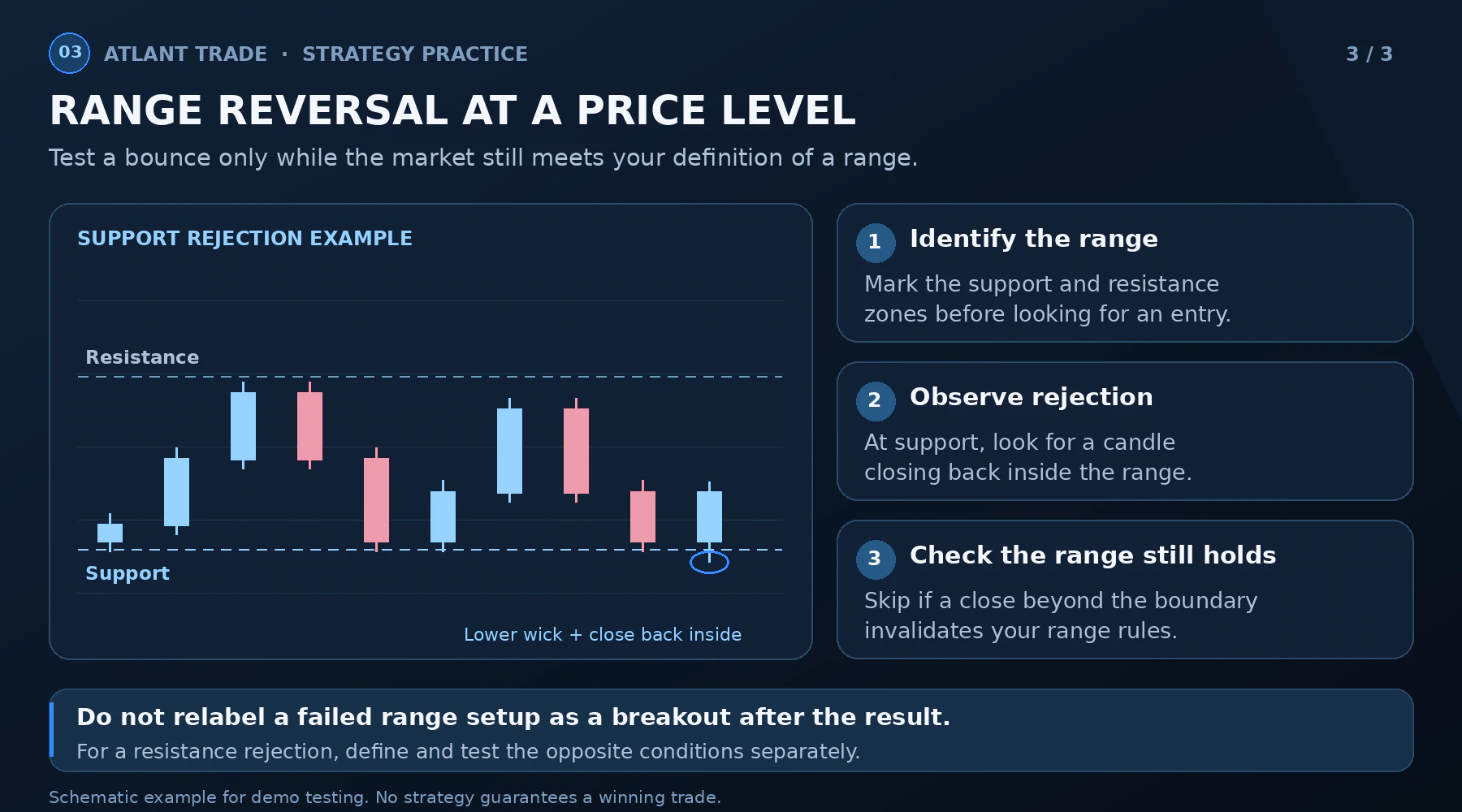
This approach is the opposite of a breakout - it assumes a level will hold rather than break, and trades the bounce.
- Identify a range the price has been moving within, with a clear top and bottom.
- Wait for price to reach one edge of the range.
- Look for a rejection candle at that level - one that pushes toward the edge and closes back away from it - before entering in the opposite direction.
The setup depends on price remaining within the range during the relevant trade period. Skip it if price closes beyond the boundary under your rules or the range is no longer clearly defined. Decide in advance whether you are testing a range reversal or a breakout; do not change the label after seeing the result.
Reading Candles Without Overreading Them
A few candle shapes come up often enough to be worth knowing, but none of them work as a signal on their own - they matter only in the context of a level or a trend:
- Engulfing pattern. A two-candle pattern in which the second candle's real body covers the previous candle's real body in the opposite direction. The real body is the open-to-close distance; the second candle does not need to cover both wicks. The pattern may support a reversal hypothesis when interpreted with the preceding price movement.
- Pin bar / long wick. A candle with a small body and a long wick on one side, suggesting price was pushed one way and then rejected - again, only meaningful at a level that already matters.
- Doji. A candle whose opening and closing prices are very close. It shows little net change during that period, even if price moved substantially within it. It does not identify the next direction on its own.
The mistake to avoid is treating any single candle shape as a standalone signal. On its own, a candle shape is a small piece of context - it becomes part of a setup only when it appears at a level or trend condition you were already watching for a specific reason.
Matching Your Expiry to the Strategy
Chart timeframe, trade duration and expiry time describe different things. The timeframe groups price data into candles; duration measures the time between the accepted entry and expiry; expiry is the exact settlement time. Changing the chart timeframe does not extend an accepted trade.
For example, a trade accepted at 14:02:20 with a 60-second duration expires at 14:03:20. A one-minute candle covering 14:02:00 to 14:03:00 closes earlier. Use the expiry recorded for the trade when reviewing its result.
There is no universally correct expiry for these setups. Define a duration or timing rule before testing and record it with every trade. If you compare different durations, treat them as separate strategy versions. A price move in the expected direction at some point after entry does not establish a winning result at the selected expiry.
Testing a Strategy Before You Trust It
None of the three approaches above are guaranteed to work for any given market or session - they're starting structures, not promises. Before risking real funds on any of them:
- Practise the setup on an Atlant Trade online trading demo account, using the exact same rules you'd use live.
- Record every completed trade and keep skipped setups separately in a trading journal.
- Review your results after a meaningful number of trades, not after two or three. A handful of wins or losses doesn't tell you whether the setup itself works.
Record the accepted entry quote, exact entry and expiry times, settlement quote, displayed payout and net result. Note ties or exceptional outcomes separately. Keep demo and live records separate, and test revised rules on new observations instead of repeatedly adjusting them to fit the same sample. See how to test a trading strategy for a structured testing process.
A Practical Demo Testing Checklist
- Can I identify the market condition required by this setup?
- Have I defined the price level and confirmation rule before entry?
- Has the confirmation candle closed?
- Is the entry still within the area allowed by my rules?
- Have I checked the trade amount, displayed payout and accepted expiry?
- Am I within my session limits?
- Will I record both the result and whether I followed the rules?
Mistakes That Undermine Otherwise Good Setups
- Trading the breakout and the reversal strategy on the same level at the same time. They contradict each other - pick one expectation before price gets there.
- Entering on a candle shape alone, with no level or trend behind it. A pattern without context is just a shape.
- Changing the expiry trade to trade "because this one feels faster." Unrecorded changes to expiry make results harder to compare.
- Abandoning a setup after one or two losses. A strategy that loses a few trades in a row isn't automatically broken - check your journal over a larger sample before deciding that.
Frequently Asked Questions
Which of These Strategies Is Best for Beginners?
None of them is inherently better - each fits a different market condition (trending, breaking out, or ranging). The more useful skill for a beginner is recognising which condition the market is actually in before picking which setup applies.
Can I Use More Than One Strategy at the Same Time?
You can, but keep them clearly separate in your journal with different labels or versions. Mixing results from different setups together makes it hard to tell which one is actually working.
How Do I Know If a Strategy Is Actually Working?
Track net result, win rate against payout, and rule adherence over a reasonable sample of trades - not just whether recent trades won. Our guide on keeping a trading journal covers the specific numbers worth tracking.
Risk notice: Trading involves a risk of losing the amount committed to a trade. Demo results and past performance do not guarantee future outcomes. This article is educational and does not provide personalised investment advice.