How to Keep a Trading Journal: A Beginner’s Guide with Demo Examples
A winning trade can still be a bad decision. A losing trade can follow every rule in your plan perfectly. If you only write down the final result, you lose the part that actually explains why it happened.
A trading journal fixes that. You record what you planned to do, what actually happened, and what's worth digging into later.
This guide gives you a simple journal template, three worked examples, and a weekly review routine you can start using right away while practising on Atlant Trade.
What Is a Trading Journal, Really?
It's a record of your trades - plus the reasoning behind them and your notes afterward. A list of completed trades from your platform can't tell you what setup you were looking at, which rules you followed, or where you changed your mind mid-decision. A journal can.
You can keep it in a spreadsheet, a notebook, or anything that lets you write consistently. A spreadsheet is easier for filtering and totals. A notebook works fine if you prefer short handwritten notes.
Whatever you use, keep two questions separate every time you review an entry:
- Outcome: What was the actual result, financial or virtual?
- Process: Did the trade actually follow the rules you wrote down beforehand?
A journal helps you answer both. It won't make a strategy profitable just because you followed its rules - that's a separate question, and one only enough data can answer.
Start in Demo Mode
An online trading demo account lets you practise keeping records with virtual money, no real risk attached. On Atlant Trade, just double-check the demo balance is selected before you start.
Keep it simple enough that you can actually update it after every trade. Pick one clear setup and one way of recording results - don't overcomplicate this on day one.
- Write your practice rules first. Asset, entry conditions, trade amount, expiry - decide before the session, not during it.
- Keep demo records separate from live ones. Never mix virtual and real results in the same tally.
- Note your reason before you enter. One sentence is enough, as long as it names the actual condition you're waiting for.
- Fill in the rest after the trade settles. Add the details, the outcome, a screenshot if you can.
- Review the session afterward. Look for missing info and rule breaks - don't rewrite your original reasoning to make it look cleaner.
If you don't have a repeatable setup yet, start with what a trading strategy should include before you open the journal.
A Simple Journal Template You Can Copy
Use these as your spreadsheet columns - one row per trade you actually took. If a note runs long, keep it in a linked doc instead of cramming it into the cell.
| Field | What goes here |
|---|---|
| Journal ID / trade reference | Your own row number, plus the platform's trade ID if you have one. |
| Account type & currency | Demo or live, and the currency your amounts are in. |
| Asset | The exact instrument, including "OTC" if that's how it's labeled. |
| Strategy version | Which version of your rules this trade used. |
| Market context & trigger | What you saw, and the specific thing that made you enter. |
| Chart timeframe | E.g. 1-minute candles. |
| Direction | Up or Down. |
| Trade amount | What you actually risked on this one trade. |
| Entry time (with timezone) | Down to the second, if your platform shows it. |
| Entry quote | The exact opening price, same precision as displayed. |
| Expiry & duration | Exact expiry time, plus how long the trade actually ran. |
| Displayed payout | And whether that number means "profit" or "total return." |
| Settlement quote & outcome | Win, loss, refund — whatever actually happened. |
| Net result | Real gain or loss, after any fees — don't count your stake as profit. |
| Rules followed? | Yes, No or Unclear, plus a short reason why. |
| Screenshots & notes | Before-and-after images, anything odd about execution. |
If you don't have a piece of information, just mark it as missing. Guessing an entry price, or writing your reason for entering after you already know the result, quietly makes the whole record less useful.
Get the Time and Payout Details Right
Chart timeframe, trade duration, and expiry time are three different things - don't collapse them into one. A 1-minute candle closing doesn't mean your trade expires at the same moment.
Example: you enter at 14:02:20 with a 60-second duration. That trade expires at 14:03:20 - not whenever the current candle happens to close. Our guide on fixed-time trading expiry breaks this down further.
Pick one timezone and stick to it throughout your journal. If you also log local time in India, label it clearly as IST (UTC+05:30) and keep the original platform timestamp next to it - don't assume the platform clock matches your local time.
Payouts deserve the same precision. Say you stake $10 at an 85% payout. A win credits you $18.50 if that figure includes your stake back - meaning your actual profit is $8.50, not $18.50. A loss simply costs you the full $10. Use whatever amount was actually credited, and don't subtract fees twice if the number you're given is already net.
Three Journal Examples You Can Learn From
These are hypothetical practice trades: $10 virtual stake, 60-second duration, 85% payout on a correct call, full loss on a wrong one. No fees, no tied outcomes - keep in mind your own trades might include those.
The rule for this exercise: you need a defined setup and a closed confirmation candle before entering. All three trades are on EUR/USD, 1-minute chart, UTC time.
| Journal field | Example 1 | Example 2 | Example 3 |
|---|---|---|---|
| Direction | Up | Down | Up |
| Entry → expiry time | 14:02:20 → 14:03:20 | 14:10:00 → 14:11:00 | 14:15:20 → 14:16:20 |
| Entry quote | 1.10000 | 1.10030 | 1.10060 |
| Expiry quote | 1.10020 | 1.10050 | 1.10070 |
| Net result | +$8.50 | −$10.00 | +$8.50 |
| Followed the rules? | Yes | Yes | No — entered early |
Example 1: A Win That Followed the Rules
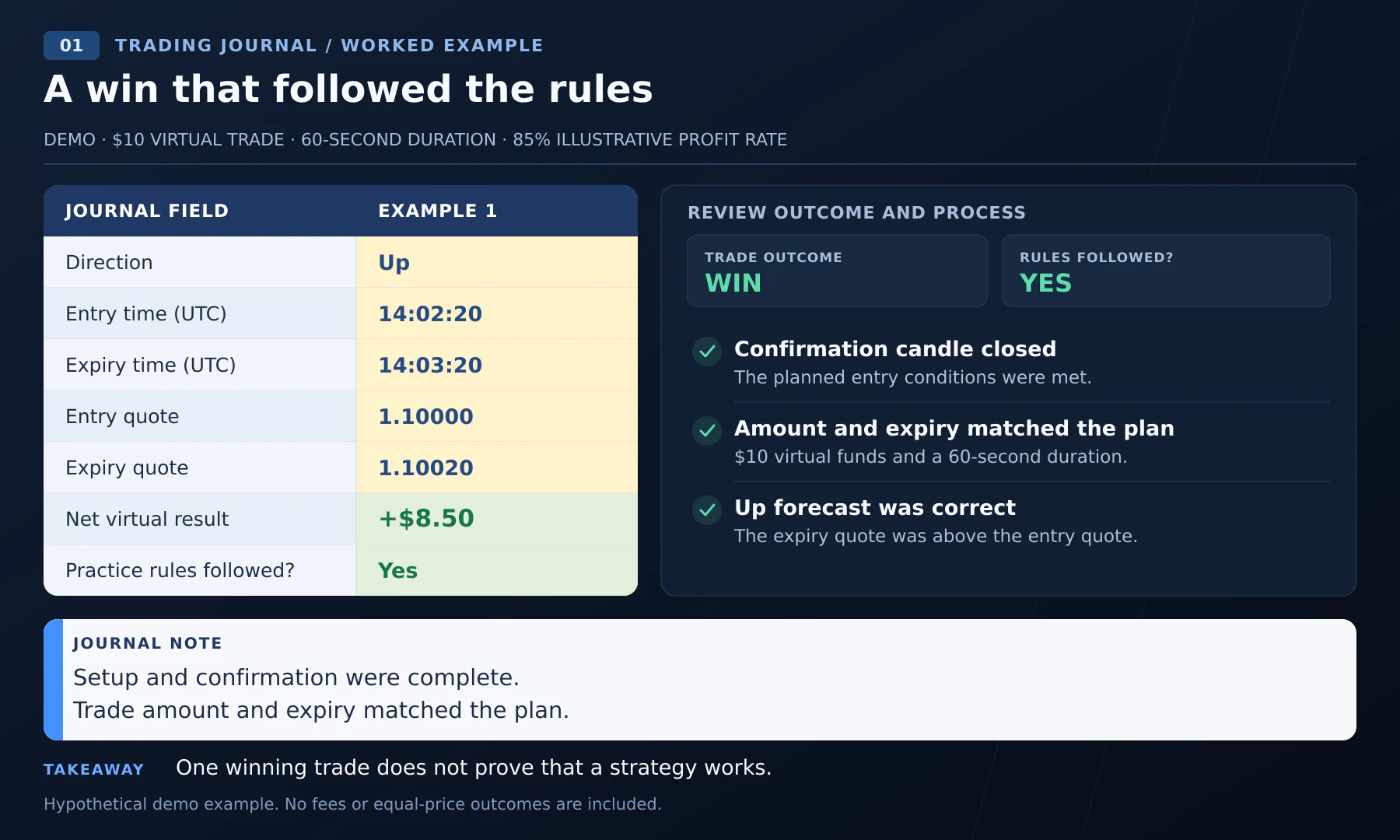
Price went up, entry conditions were met, and the confirmation candle had already closed. A good note to write is: "Setup and confirmation both checked out. Amount and expiry matched the plan." One good trade doesn't prove the strategy works - it's just one clean data point.
Example 2: A Loss That Still Followed the Rules
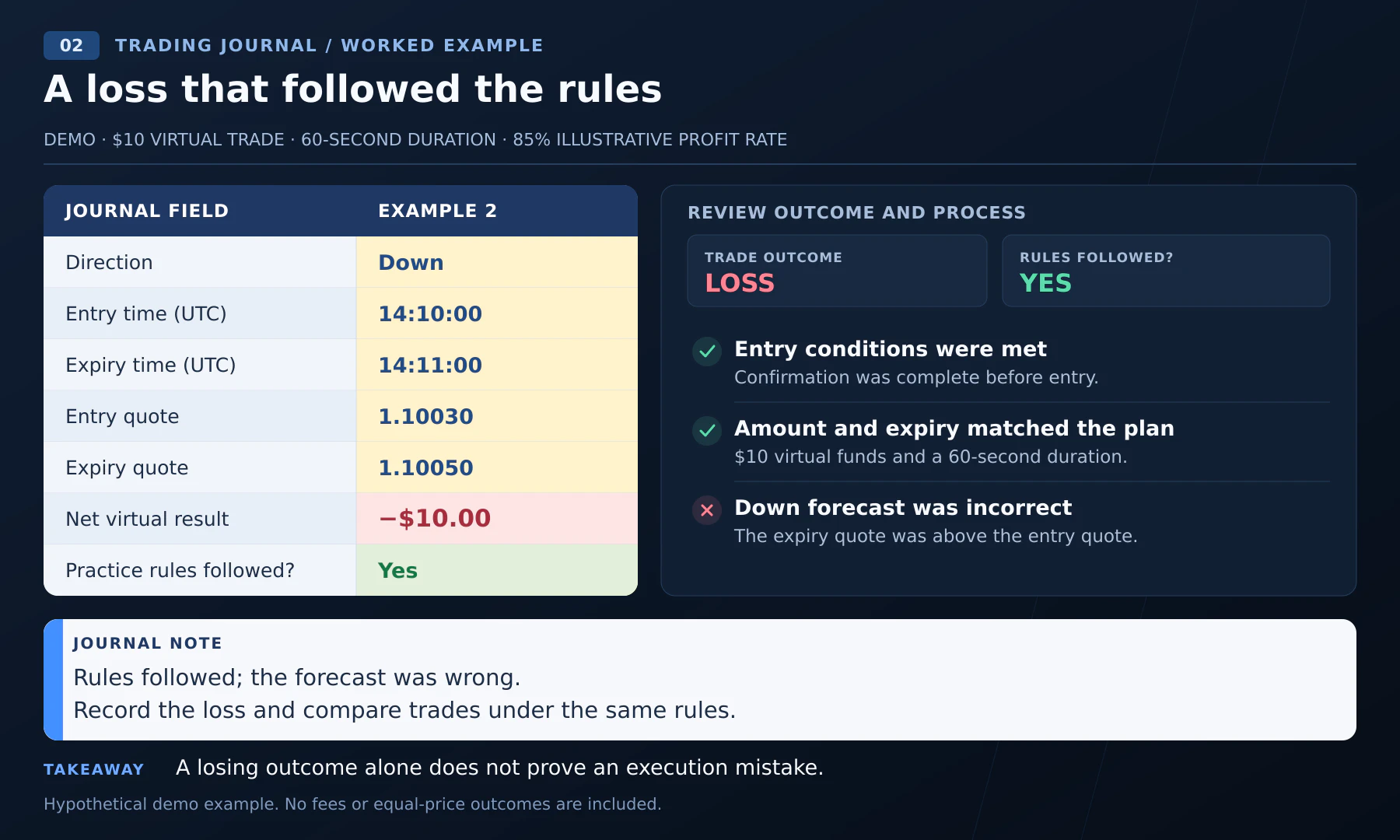
The forecast was simply wrong, even though everything was done correctly. A good note is: "Rules followed, forecast didn't play out. Log the loss and compare it against other trades under the same rules." Don't retroactively invent a mistake just because it lost.
Example 3: A Win That Broke the Rules
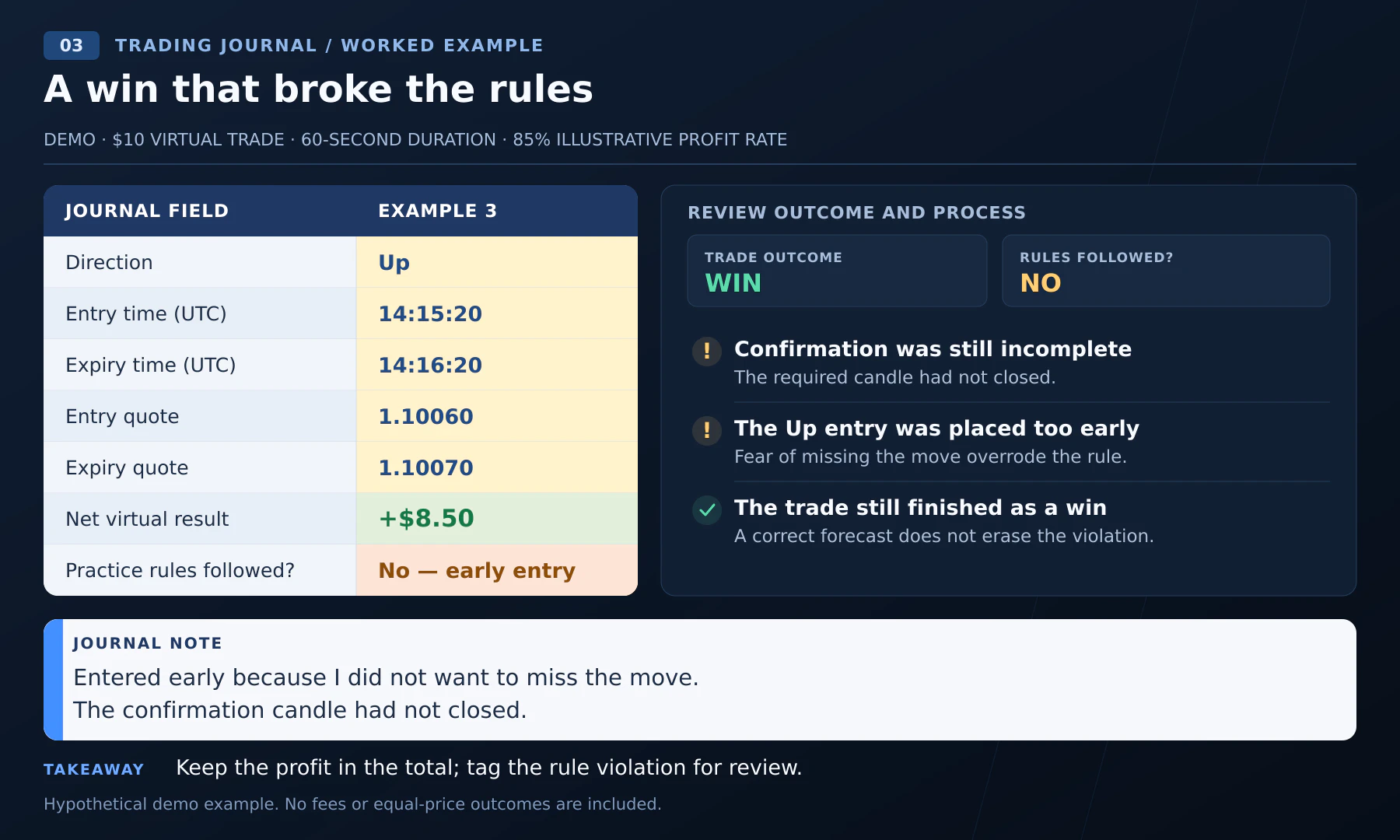
Entry happened before the confirmation candle closed - and it still won. Log both facts honestly: "Jumped in early because I didn't want to miss the move. Confirmation wasn't actually complete." Keep the result in your overall total, but tag it separately when you're judging how well the actual setup performs - a lucky early entry isn't the same as a disciplined one.
Reviewing Your Journal Every Week
Pick a regular time to review - not while you're actively trading. Even with too few trades to judge a strategy properly, a weekly look can still catch missing entries and repeated habits.
- Check it's complete. Match entries against your actual transaction history. Include the losses and the trades you'd rather forget.
- Don't mix unlike things. Review demo and live separately. Group by strategy version, asset, or condition if that's useful.
- Count your rule breaks. Early entries, wrong trade size, wrong expiry - name the specific pattern, don't just eyeball it.
- Run the numbers. Net result, win rate, and - just as important - how big your losses are compared to your wins.
- Write one testable observation. For example: "I entered before confirmation in 4 of 12 trades this week."
- Set up the next check. Does that pattern repeat next week? If you change a rule, give it a new version number and track it separately from here on.
A pattern in a small sample is worth investigating - it's not proof that one asset, session, or expiry length is genuinely better. And don't slice your data into so many tiny subgroups that each one only has a trade or two in it; that's how you talk yourself into noise.
The Numbers That Matter More Than Win Rate
Net Result
Add up every trade's net result. Keep deposits, withdrawals, bonuses and demo resets out of this number - otherwise a bigger balance can look like better trading when it isn't.
Win Rate and Payout, Together
Win rate = wins ÷ (wins + losses) × 100. Report refunds separately so this number stays clean.
But win rate alone can lie to you. Take 100 trades, $10 each: 50 wins at 85% payout earn $425. 50 losses cost $500. Net result: −$75, despite winning exactly half your trades. If your stakes or payouts vary trade to trade, always check the actual dollar result - a single win-rate percentage hides too much.
Average Net Result per Trade
Total net result ÷ number of settled trades in that group. This describes what already happened in your sample - it's not a prediction of what your next trade will do.
Rule Adherence
How many trades genuinely followed every rule? Keep "unclear" cases separate instead of assuming they counted. This tells you whether a bad week came from the rules themselves or from inconsistent execution.
Drawdown
Track how far your results fall from their previous peak. For a simple closed-trade view: start with a fixed balance, add your cumulative net results (no deposits or resets), and watch the dips between settled trades. This won't capture risk while a trade is still open - for that, see our guide on controlling trading risk.
Mistakes That Quietly Ruin a Journal
- Writing your reason after you already know the result. Keep your original note untouched; add later thoughts as a separate line.
- Only logging the memorable trades. Skipping small losses and boring wins skews everything.
- Judging the result by candle colour. Compare your actual entry and settlement quotes instead.
- Rounding prices too early. Keep the full precision - small differences matter more than they look.
- Mixing different rule versions together. Label every change so your review shows which version produced which result.
- Wiping out demo losses with a balance reset. Log the reset itself, and keep the trade history that came before it.
- Taking extra trades just to "fill in" the day. If nothing meets your setup, log a no-trade session instead of forcing one.
Quick Questions Beginners Usually Ask
Do I Need Special Software?
No. A basic spreadsheet covers everything in the template above. Pick whatever lets you keep consistent entries, attach screenshots, and reread old notes easily.
How Many Trades Before I Can Draw Conclusions?
Log every trade from day one - there's no magic number. What matters more is consistency and how independent the trades actually are. Ten trades off the same market move tell you a lot less than ten trades from genuinely different setups.
Should I Log Setups I Decided Not to Trade?
Yes - but in a separate log. Note why you skipped it (no confirmation, hit your session limit, whatever it was). Just don't count the hypothetical profit from a skipped trade toward your real performance.
Does a Profitable Demo Journal Mean I'm Ready for Live Trading?
No. It shows what happened during that specific stretch of practice. Real money changes behavior, and live conditions can differ from demo ones. A good demo record is a starting point, not a green light.
Build a Record You Can Actually Learn From
Start with one clear set of rules and a journal you'll realistically keep updating. The downloadable template above already has the structure ready - just fill in Practice Rules, then start logging trades. For every practice trade on Atlant Trade, write down the plan, log the real details, and judge the result separately from how well you executed.
The real payoff of a review isn't the win rate - it's one specific thing you can go check again: where your records fall short, which rule you keep breaking, or which assumption still needs testing.
Risk notice: Trading involves the risk of losing the amount you commit to a trade. Demo results, journal entries and previous performance do not guarantee future outcomes. This article is educational and does not provide personalised investment advice.