Demo Trading vs Live Trading on Atlant Trade: What Changes?
The main difference between demo trading and live trading is what happens to your money. On Atlant Trade, demo trades use virtual funds. Live trades use a real account balance, and an incorrect forecast can cost the full amount committed to the trade.
The platform may feel familiar after practice, but familiarity with the controls does not guarantee the same results with real funds. Your decisions can change under financial pressure, and a successful demo period may not represent the conditions you encounter later.
This guide explains how to use the Atlant Trade demo account, what to review before switching to live trading, and how to compare your decisions without confusing a profitable result with a well-followed plan.
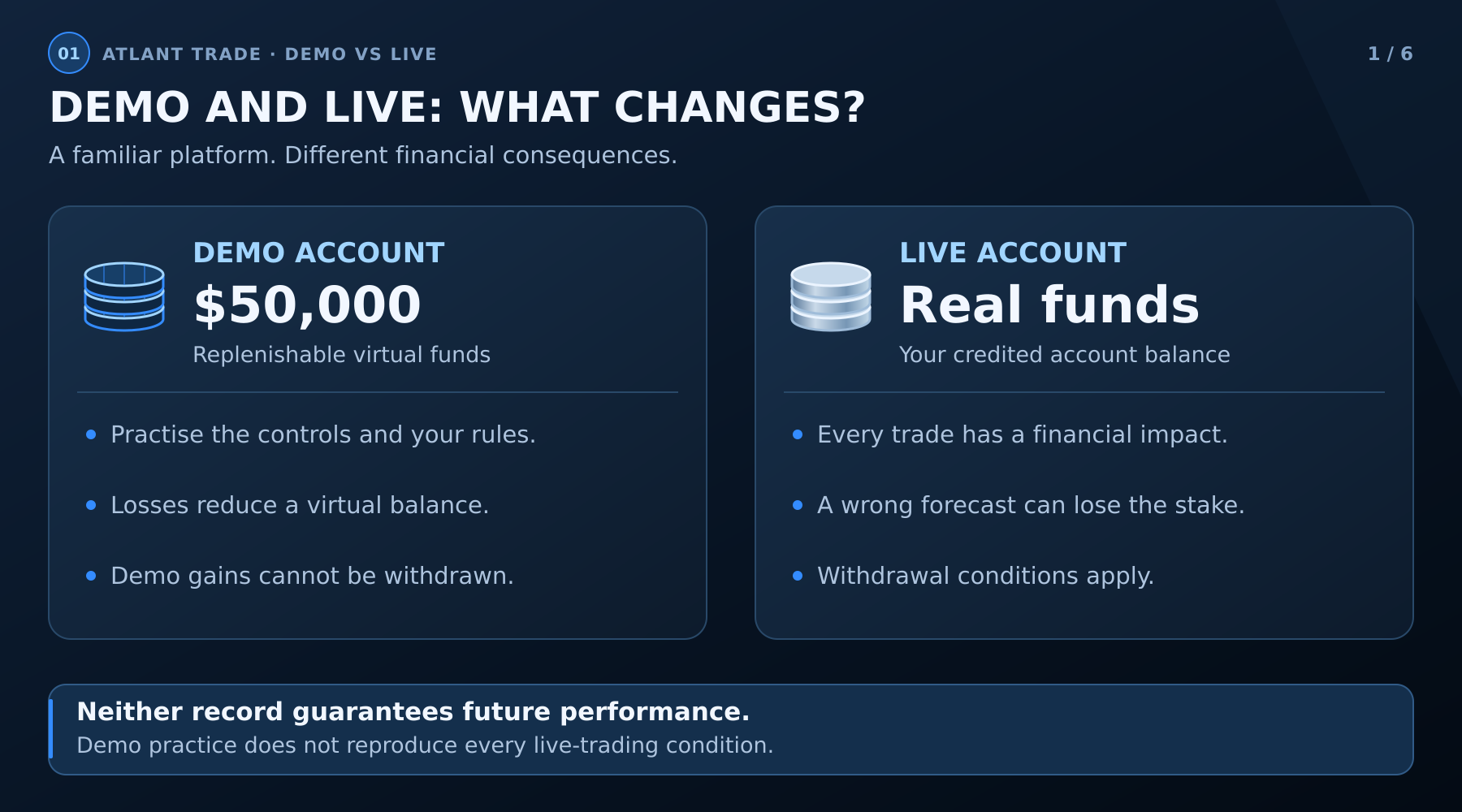
Demo vs Live Trading on Atlant Trade at a Glance
| What you are comparing | Demo account | Live account |
| Funds | A $50,000 virtual practice balance that can be replenished. | Real funds credited to your trading account. |
| Effect of a loss | Reduces the virtual balance. | Reduces your real trading balance. |
| Purpose | Learn the controls and practise a defined process. | Make trading decisions with actual financial consequences. |
| Withdrawal | Virtual funds and demo gains cannot be withdrawn. | Withdrawals are subject to account verification and payment conditions. |
| What results establish | What happened during a particular practice period. | What happened to real funds during a particular trading period. |
Neither record guarantees future performance. The demo environment provides practice with key platform functions, but it does not reproduce every condition of live trading.
How to Use the Atlant Trade Demo Account
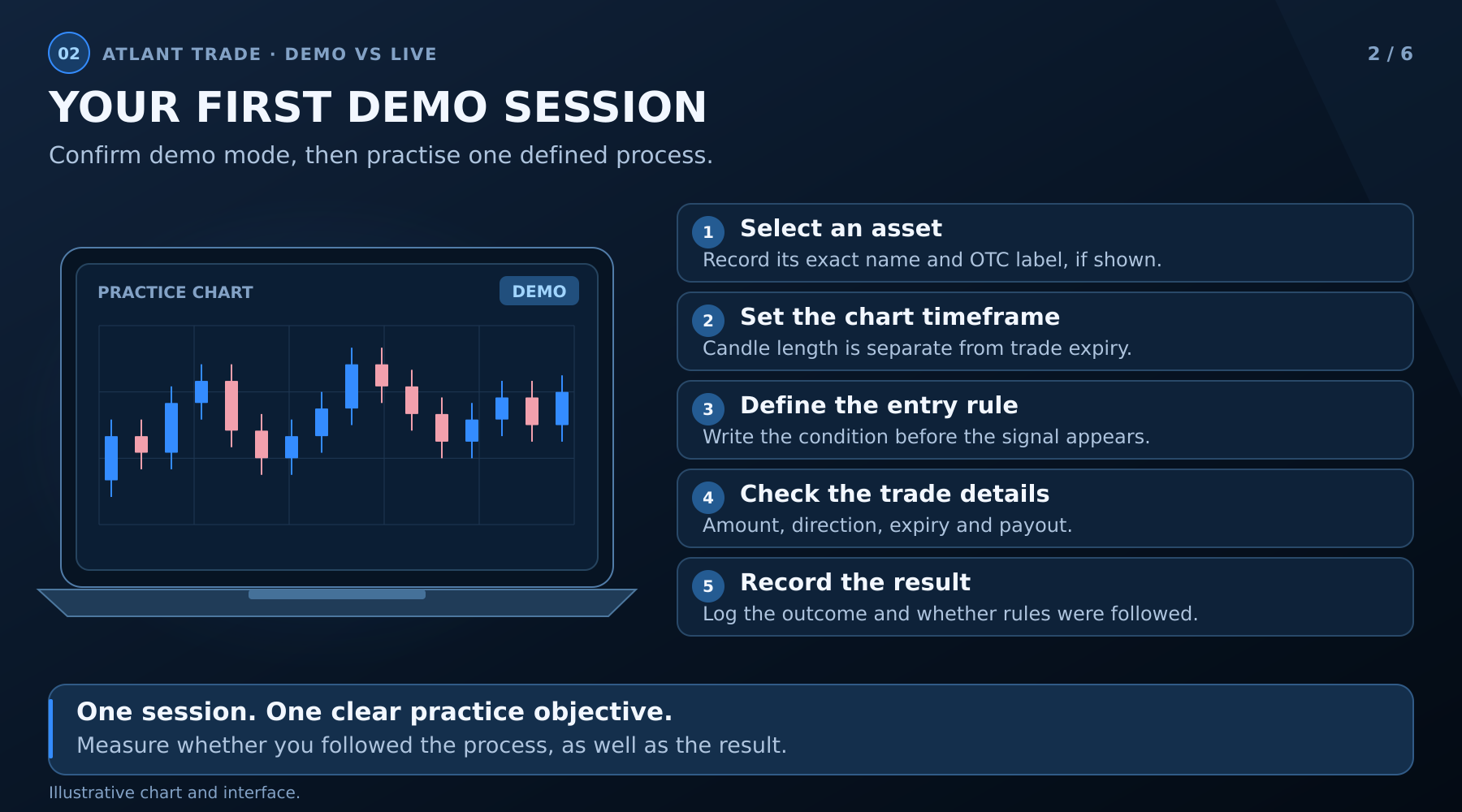
Registration is free, and you can practise before depositing. Use the account selector to choose the demo balance, then check that the displayed account is the one you intend to use. Repeat that check whenever you switch between practice and real-money sessions.
A useful first session has a specific objective:
- Select an available asset. Note its exact name, including an OTC label if one is shown.
- Set the chart timeframe. Understand how much time each candle represents. This is separate from the trade's expiry.
- Write one entry condition. Decide what must happen before you are allowed to open a practice trade.
- Check the trade details. Confirm the virtual amount, Up or Down direction, expiry and displayed payout before submitting the trade.
- Review after settlement. Record the result and whether the trade followed your written condition.
The Atlant Trade demo account guide explains the practice balance and account controls in more detail.
Give the Practice Balance a Realistic Meaning
A large virtual balance can make trade amounts feel unimportant. To practise budgeting, track a smaller hypothetical allowance in your own journal and measure each trade against it. This does not require changing the balance displayed by the platform.
If you replenish demo funds, record that separately. Adding virtual funds should not erase a losing sequence from your review or make the strategy appear more successful.
What Can Change When Real Money Is Involved?
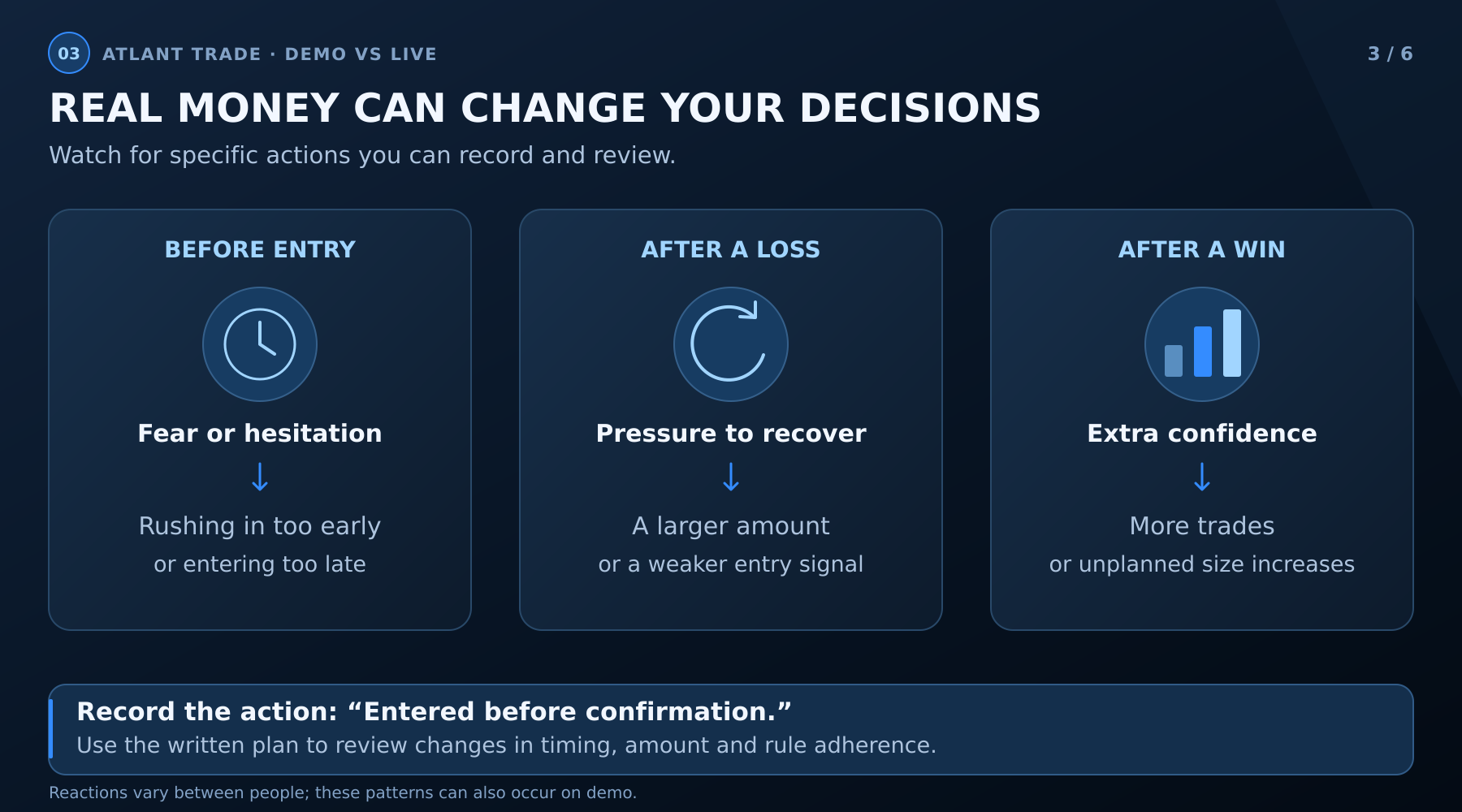
1. The Same Setup Can Feel Harder to Take
You may hesitate on a live entry that you would have taken on demo, then enter after the planned opportunity has passed. You may also experience the opposite reaction: rushing into a trade because you are worried about missing a move.
Record the behaviour precisely. "Entered before confirmation" is more useful than "felt nervous", because it identifies a decision you can review.
2. A Loss Can Create Pressure to Recover Immediately
A live loss can make the next trade feel like a chance to repair the previous result. That pressure may lead to a larger amount, a different expiry or a weaker entry condition.
Each of those changes makes the next decision different from the process you tested. A previous loss does not, by itself, make the next forecast more likely to succeed.
3. A Win Can Encourage Unplanned Risk
After a live win, it can be tempting to increase the amount or take extra trades. A short winning streak, however, does not establish that a strategy has become more reliable.
Keep any planned change to trade size separate from your reaction to the latest result. Emotional responses vary between people, and some of these habits can also appear during demo practice.
Why Different Results Are Not Always About Psychology
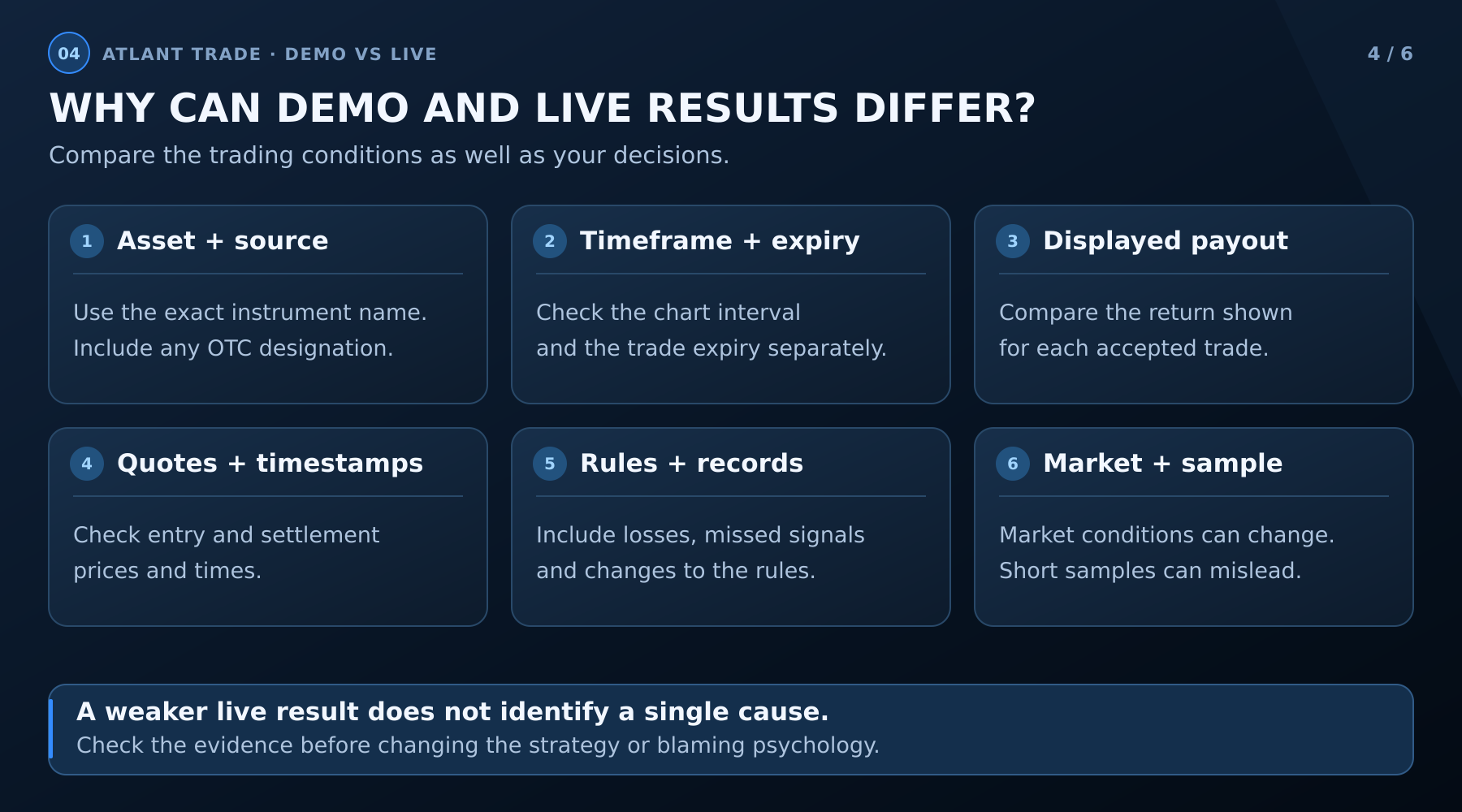
If live results are weaker than demo results, do not automatically conclude that the strategy is sound and discipline is the only problem. The original test may have been too short, the market may have changed, or the rules may never have demonstrated a reliable advantage.
Compare the actual conditions:
- Was it the same instrument and price source?
- Were the chart timeframe, entry rule and expiry consistent?
- Were the displayed payouts comparable?
- Did the accepted entry quote and timestamp match what you recorded?
- Were all losses, missed signals and rule changes included in the review?
- Could the difference reflect ordinary variation in a small sample?
For a fixed-time trade, a change in the entry or settlement quote can affect the result. Review the accepted trade details instead of judging it only by candle colour. Our explanation of how fixed-time trading works covers entry, expiry and payout mechanics.
Before Moving from Demo to Live on Atlant Trade
Using a demo account does not create a deadline for depositing. If you decide to use real funds, work through these checks before your first live session.
- Keep a written version of your strategy. Define the entry condition, direction, expiry rule, sizing method and reasons to skip a setup. If you change the rules, label the new version separately.
- Set an affordable loss budget. Use only money you can lose without affecting essential expenses or financial commitments. A deposit minimum does not establish an appropriate personal budget.
- Check whether the trade amount fits that budget. Atlant Trade's minimum deposit is $10 and the minimum trade amount is $1. A $1 trade exposes 10% of a $10 balance. If the smallest trade exceeds your chosen limit, continue on demo rather than forcing a live trade.
- Review funding and withdrawal conditions. Check the payment methods available in your account, verification requirements and any external payment or conversion charges before depositing.
- Set session limits in advance. Include the possible loss on any open trades when deciding whether another trade would exceed the limit. A limit written in your journal is a rule you monitor yourself; it does not activate an automatic platform stop.
- Confirm the selected account and order details. Check the real-money balance, amount, direction, expiry and payout before submitting. Do not assume that settings left over from a demo session match your live plan.
Our guide to Atlant Trade minimum deposits, fees and processing times explains the payment side. For a structured practice process, read how to test a trading strategy with backtesting and forward testing.
Use Trading History and a Journal Together
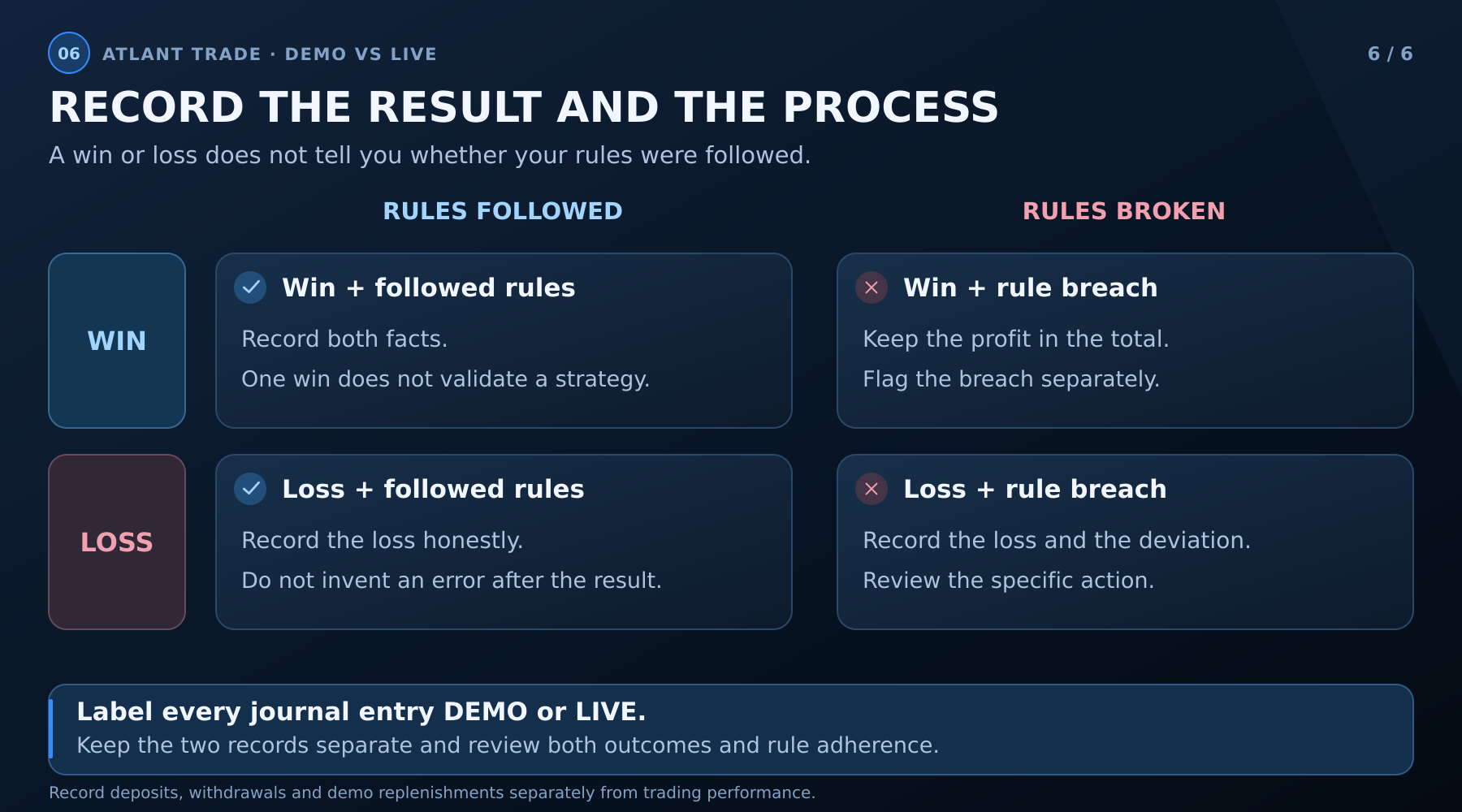
Atlant Trade's trading history records completed trade results. Your journal adds the reasoning behind them: the setup you expected, the amount you planned, whether you waited for confirmation and any departure from the rules.
Mark every entry as demo or live. Keep their results separate, and record the asset, entry and expiry details, trade amount, payout, net result and rule adherence. Keep deposits, withdrawals and demo replenishments separate from trading performance.
Suppose a demo trade wins after you enter before the confirmation candle closes. It is still a rule breach. If a later live trade follows the plan and loses, the loss alone does not prove that the decision broke your rules. At the same time, following a rule consistently does not prove that the rule is profitable.
The trading journal guide shows how to record outcomes and decision quality separately.
When to Return to Demo Practice
Consider pausing live trading if you repeatedly change the amount after a loss, enter without the required confirmation or cannot explain how the result was determined. Demo practice can help you work on the specific issue without exposing more real funds.
Give the next practice period a clear task, such as checking every expiry before confirmation or recording every skipped setup. If you change the strategy itself, begin a new test record. Returning to demo is also reasonable when the cause of a performance difference remains unclear.
Frequently Asked Questions
Can I Use the Atlant Trade Demo Account Without Depositing?
Yes. You can register and practise with virtual funds before making a deposit. Always check that the demo account is selected before starting a practice session.
Can I Withdraw Profits Made on Demo?
No. Demo funds have no cash value. Practice gains cannot be withdrawn or treated as real trading income.
How Long Should I Practise Before Going Live?
There is no universal number of days or trades that establishes readiness. Review whether your records are complete, your rules are clear and you can follow the process consistently. Even a positive, carefully recorded test cannot guarantee live profits.
Should I Use the Same Trade Amount on Demo and Live?
Do not copy a demo amount simply because it is familiar. Assess the amount against the real balance and your affordable loss limit. You can practise that sizing method with a separate notional budget in your journal before risking actual funds.
Does a Familiar Interface Mean Demo and Live Conditions Are Identical?
No. Knowing the controls is useful, but it does not establish identical trading conditions or emotional responses. Review each trade's actual parameters and keep the two account records separate.
To put this into practice, open Atlant Trade, select the demo account and choose one behaviour to record during your next session. Review how you made each decision before deciding whether to change the strategy or account type.
Risk notice: Fixed-time trading involves a high risk of loss. You can lose the full amount committed to a trade and, through repeated trading, all funds in your trading account. Demo results and past performance do not guarantee future outcomes. This article provides educational information, not personalised financial advice.