How Much Money Do You Need to Start Trading?
You can start learning on Atlant Trade without making a deposit. Registration is free, and the demo account lets you practise with virtual funds. If you choose to trade with real money, the minimum deposit is $10 and the minimum trade amount is $1.
Those two numbers answer different questions. The deposit minimum determines how little you can add to your account. Your trade amount determines how much you can lose on an incorrect forecast. Before funding an account, work out how those amounts fit your budget and the rules you intend to follow.
This guide explains how to use Atlant Trade's demo environment, calculate the share of your balance exposed to each trade, and build a position-sizing routine you can review.
Atlant Trade Starting Amounts at a Glance
| Item | Amount | What it means |
| Registration | Free | You can create an account before deciding whether to deposit. |
| Demo account | $50,000 in virtual funds | A practice balance with no cash value. |
| Minimum deposit | $10 | The platform's funding minimum, not a suggested budget. |
| Minimum trade amount | $1 | The smallest trade amount, not a recommended amount to risk. |
Check the amount and currency shown in your account before confirming a payment. Available payment methods and provider conditions can vary. Our guide to Atlant Trade minimum deposits, fees and processing times explains the funding details.
Start with the Atlant Trade Demo Account
The Atlant Trade demo account gives you a place to learn the controls before real money is involved. Select the demo balance, open an available asset and practise checking the trade amount, direction, expiry and potential payout.
When learning position sizing, set a smaller practice budget in your own journal instead of treating the entire $50,000 virtual balance as your spending allowance. For example, you could track a hypothetical $100 budget and deduct each practice loss from it. This is a bookkeeping exercise; it does not require changing the platform's displayed demo balance.
That approach lets you see whether your sizing rule would still work with a smaller account. Keep the practice budget and the platform balance clearly separated in your records. Demo funds cannot be withdrawn, and positive demo results do not guarantee the same results with real money.
Why a $10 Deposit and a $1 Trade Need Different Decisions
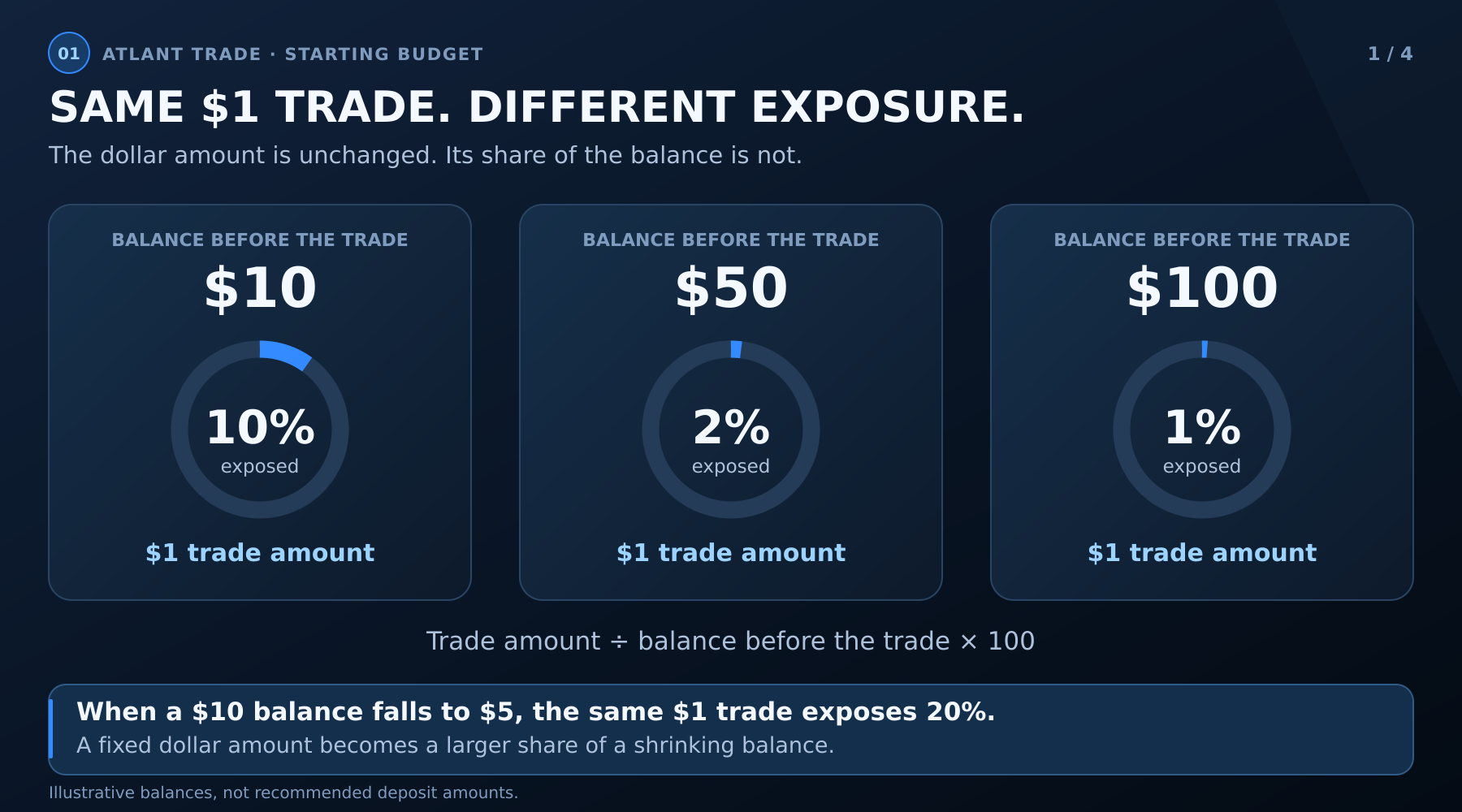
A $1 trade may look small in isolation. Its effect depends on the balance behind it:
| Balance before the trade | Trade amount | Share of balance exposed |
| $10 | $1 | 10% |
| $50 | $1 | 2% |
| $100 | $1 | 1% |
With a $10 starting balance, five consecutive unsuccessful $1 trades leave $5, assuming no other transactions or charges. Another $1 trade would then expose 20% of the remaining balance. The dollar amount stayed the same, but its relative impact doubled.
This comparison is not a reason to deposit more. It shows why the minimum deposit does not automatically support a low-percentage sizing rule. If the smallest available trade exceeds your chosen limit, you can continue practising on demo instead of increasing your financial commitment.
What Position Size Means in an Atlant Trade Fixed-Time Trade
For a fixed-time trade, position size is the amount you commit to the forecast. If the forecast is incorrect at expiry, the full trade amount can be lost. Choosing an asset does not mean buying and owning that currency or cryptocurrency.
The basic calculation is:
Share of balance at risk = Trade amount ÷ Balance before the trade × 100
For example, a $2 trade opened from a $100 balance exposes 2% of that balance. A $5 trade from the same balance exposes 5%. These figures describe the possible loss relative to the account, not the probability of a losing result.
Changing the chart timeframe or choosing a different expiry does not reduce the amount committed. The expiry controls when the forecast is evaluated. Our explanation of how fixed-time trading works covers settlement and payout mechanics.
Fixed Amount or Fixed Percentage?
Two common ways to define trade size are a fixed monetary amount and a fixed percentage of the balance. Either needs a written rule and a review process.
| Question | Fixed amount | Fixed percentage |
| How is size selected? | Use the same chosen amount for each qualifying trade. | Calculate the amount from the balance before each trade. |
| What happens after losses? | The amount stays unchanged and becomes a larger percentage of the remaining balance. | The calculated amount decreases as the balance falls. |
| What happens after gains? | The amount stays unchanged and becomes a smaller percentage of the balance. | The calculated amount increases as the balance grows. |
| What needs checking? | Whether the unchanged amount still fits your loss limits. | Whether the calculated amount fits the platform minimum and supported increments. |
You may encounter guidelines such as risking 1% or 2% per trade. These are planning conventions, not universal safety thresholds or guarantees that a losing streak will be manageable. A percentage should not replace an assessment of what you can afford to lose.
When the Calculated Amount Falls Below the Minimum
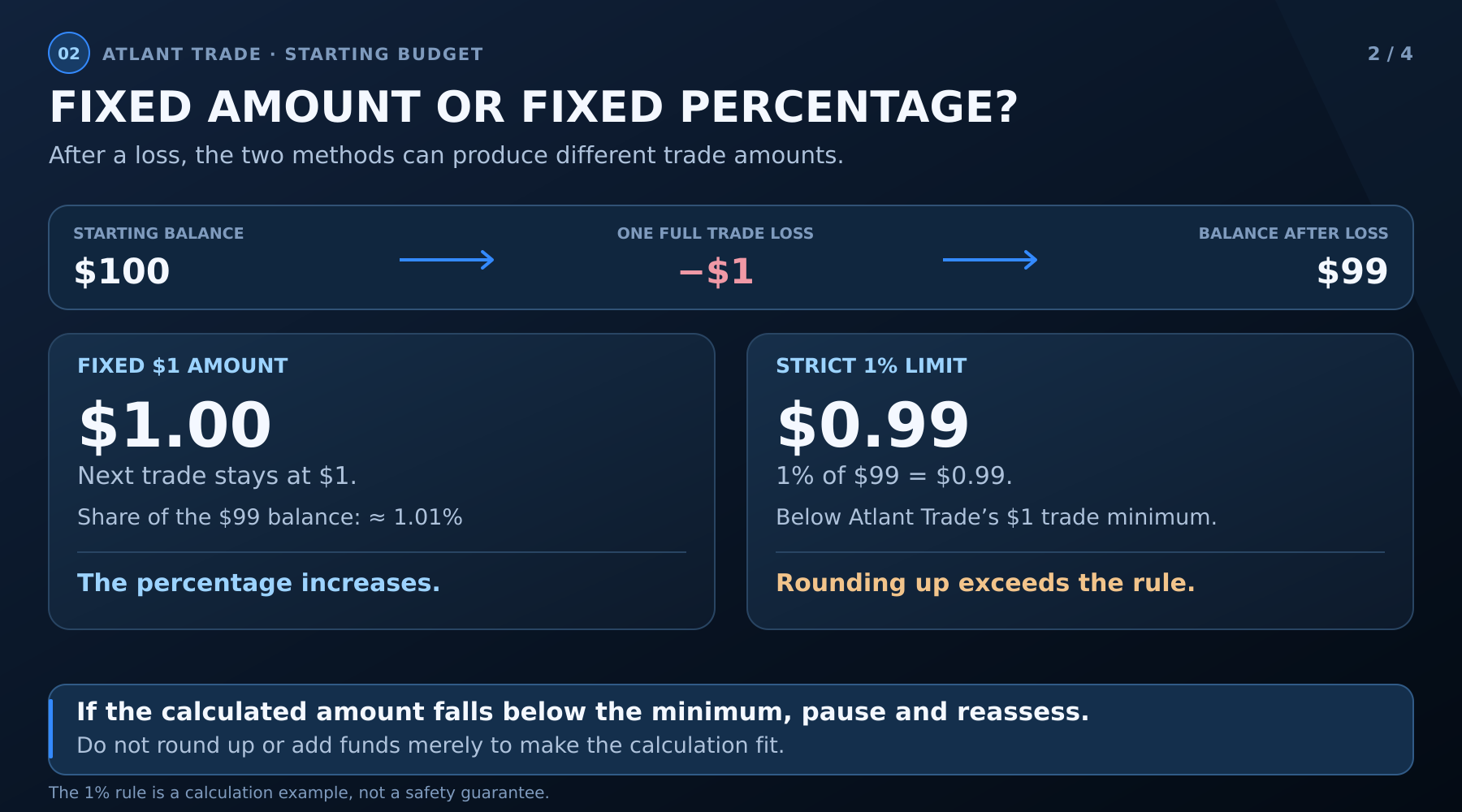
Suppose your practice rule allows no more than 1% per trade. With a $100 balance, that permits $1. After one full $1 loss, the balance is $99 and the next calculated limit is $0.99.
Because Atlant Trade's minimum trade amount is $1, another $1 trade would exceed that strict 1% rule. Rounding up does not preserve the limit. Pause real-money trading and reassess the plan, or continue the exercise with virtual funds. Do not add money merely to make the calculation fit.
Include Payouts and Open Trades in Your Budget
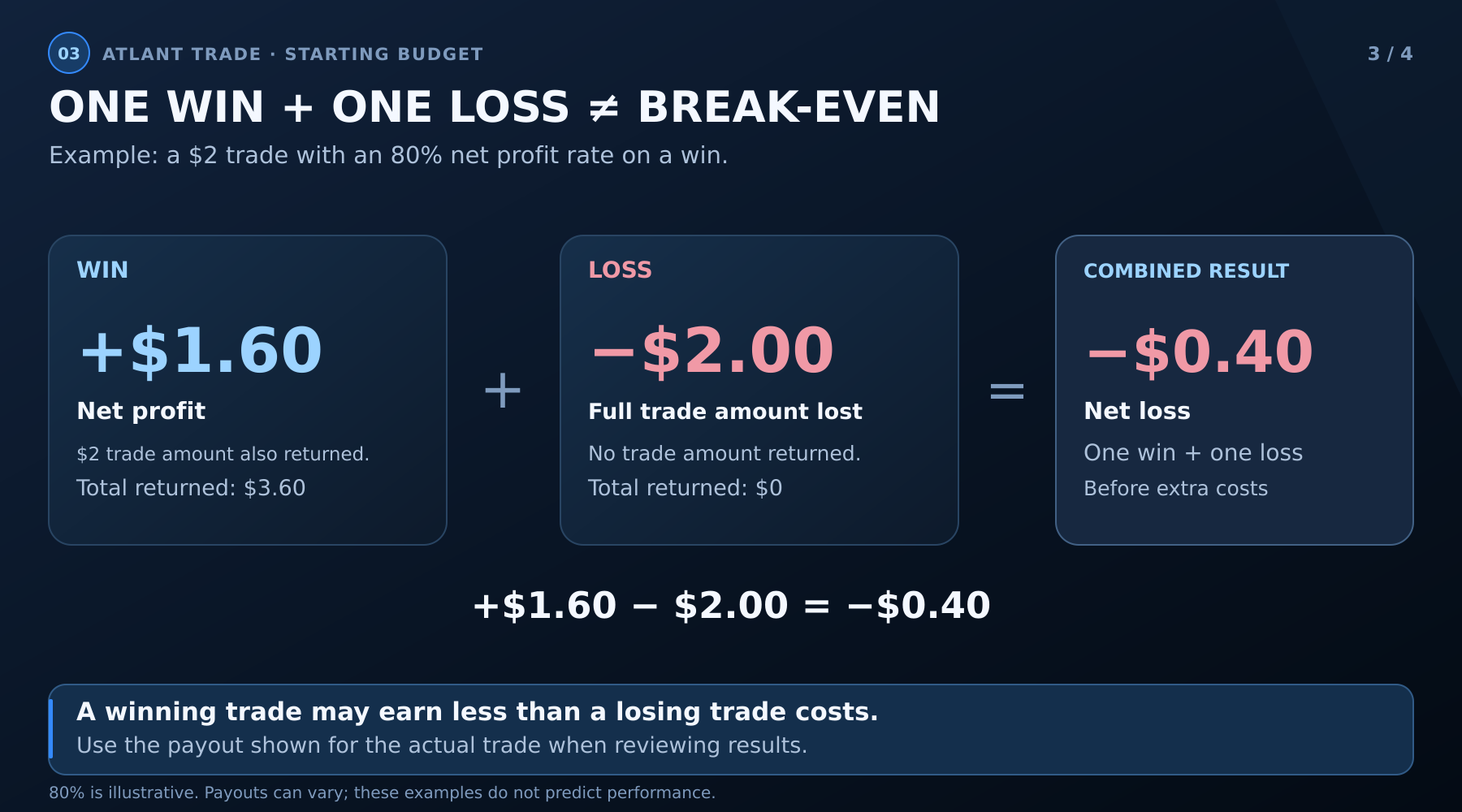
Trade size is only one part of the calculation. The potential profit on a correct forecast can be smaller than the amount lost on an incorrect one.
For illustration, suppose a $2 trade offers 80% net profit on a correct forecast. A win adds $1.60 in profit, with the $2 trade amount returned. A loss costs $2. One win and one loss therefore produce a net loss of $0.40 before any additional costs. The 80% rate is an example; use the payout shown for the actual trade.
Count simultaneous exposure too. Three $2 trades opened from a $100 starting balance put $6, or 6% of that starting balance, at risk together. A limit applied to each trade separately does not automatically limit the combined loss. Related assets can also move in response to the same event.
A Position-Sizing Exercise on Atlant Trade
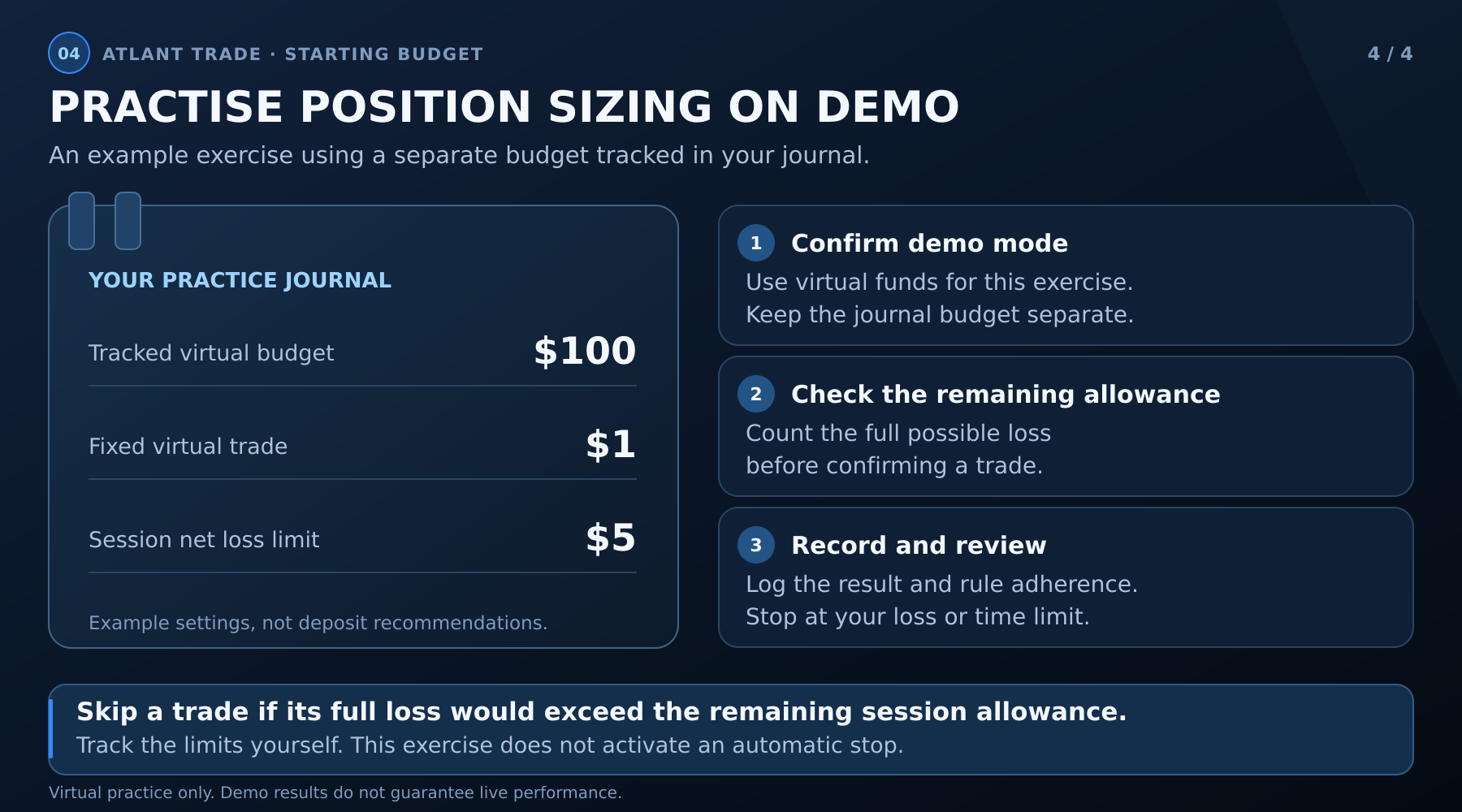
Use this exercise to connect the amount shown in the trade ticket with a written budget. The numbers below are hypothetical practice settings, not recommended deposit amounts.
- Select demo mode. Confirm that the virtual balance is active before placing any practice trade.
- Write a practice budget. For example, track $100 in your journal, use a fixed $1 virtual trade amount and set a maximum net loss of $5 for the session. Record which sizing method you are testing.
- Define one setup. Choose an available asset, a chart timeframe, an entry condition and an expiry rule before looking for a trade.
- Check the amount before confirmation. Calculate its share of your tracked budget. Skip the trade if a full loss would exceed your remaining session allowance. Recheck the direction, expiry and displayed payout alongside it.
- Keep the exercise to one open trade at a time. This makes it easier to track exposure and apply the session limit. It is a practice rule, not a platform restriction.
- Update the journal after settlement. Record the net result, the remaining practice budget and whether you followed the rules. Stop when the predefined loss or time limit is reached.
Your session limit is a rule you monitor yourself in this exercise. Do not assume that writing it down activates an automatic stop on the platform. If you later allow several open trades, include their possible losses before accepting another trade.
A session without a qualifying setup can end with no trades. Once the controls are familiar, follow a more complete process for backtesting and forward testing a trading strategy. A short exercise can reveal an interface mistake; it cannot establish future profitability.
Before Funding Your Atlant Trade Account
If you decide to use real funds, set your affordable loss budget before opening the Deposit section. Money needed for essential expenses, debt payments or emergencies does not belong in that budget.
Then review the payment details inside your account:
- Amount credited: check how much will reach the trading balance after any conversion or external charge.
- Payment method: use an available method in your own name and follow any verification request.
- Fees: Atlant Trade does not charge its own deposit or withdrawal commission, but a bank, payment provider or network may charge separately.
- Withdrawal conditions: review the available methods, applicable limits and verification requirements before depositing.
If your payment starts in INR or another currency, use the conversion shown by the payment provider rather than an indicative rate from a search result. Keep the payment reference, and wait until the funds are credited before treating them as available.
Increasing a deposit does not improve a strategy's accuracy. Keep any later funding decision separate from the urge to recover a recent loss.
Use Your Trading History to Check the Plan
Atlant Trade's trading history helps you review completed transactions. Your own journal adds the information needed to explain the decisions: the budget used for sizing, the planned amount, the actual amount, the reason for entry and any rule breach.
Review whether the amount increased after a win or loss, whether a shrinking balance pushed a fixed amount above your limit, and whether several trades created more combined exposure than planned. Keep deposits and withdrawals separate from trading results so that adding funds does not look like improved performance.
Our trading journal guide includes worked examples and a review routine. For broader planning, see controlling trading risk.
Frequently Asked Questions
Can I Start Using Atlant Trade Without a Deposit?
Yes. You can register and practise with the demo account before making a deposit. Its balance is virtual, so practice gains cannot be withdrawn as real money.
Is $10 Enough to Start Trading on Atlant Trade?
It meets the platform's minimum deposit. However, a $1 trade exposes 10% of a $10 balance. Whether that fits your plan is a separate decision. If it exceeds your loss limit, remain on demo rather than forcing a real-money trade.
Does a 1% Rule Make Trading Safe?
No. A sizing limit controls the amount exposed to an individual trade. It does not make the forecast reliable, prevent repeated losses or guarantee that the strategy is profitable. The 1% figure in this guide is a calculation example.
Should I Multiply My Trade Amount by the Number of Test Trades to Choose a Deposit?
No. That calculation does not establish an affordable or appropriate budget. You can collect practice observations on demo without funding an equivalent number of real-money trades. Decide your financial limit independently of how much testing a strategy needs.
When Should I Increase My Trade Amount?
A recent win, loss or larger deposit is not enough reason. Any change should follow a defined sizing method, fit your financial limits and be evaluated separately from the previous version of your plan. You can test a change on demo first.
To put the process into practice, open Atlant Trade, select the demo account and write down your practice budget before the first trade. Check whether you can follow the amount and session limits consistently before making a separate decision about real funds.
Risk notice: Fixed-time trading involves a high risk of loss. You can lose the full amount committed to a trade and, through repeated trading, all funds in your trading account. Demo results and past performance do not guarantee future outcomes. This article is educational information, not personalised financial advice.